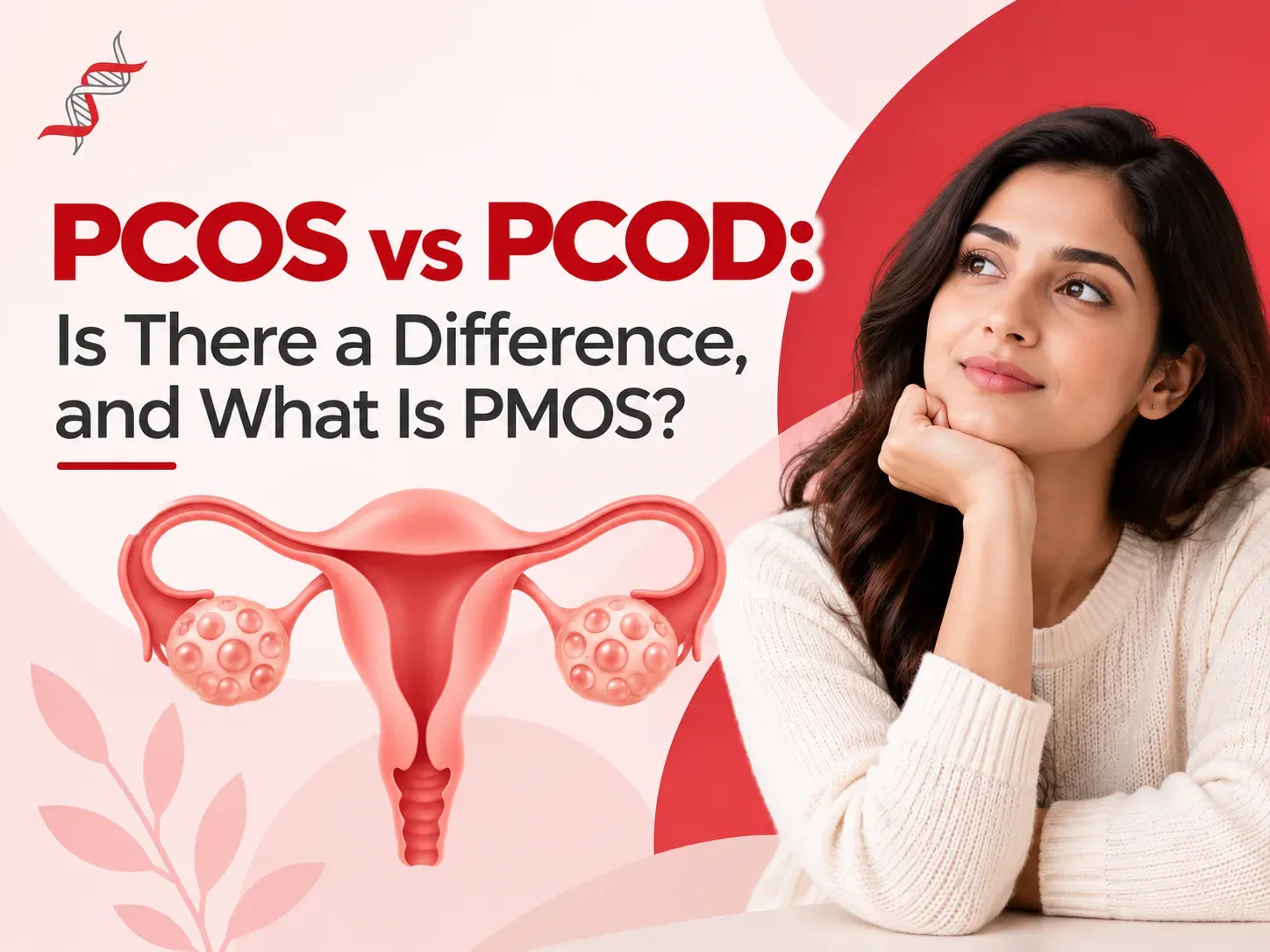
PCOS vs PCOD: Is There a Difference, and What Is PMOS?
PCOD and PCOS are two names for one condition, now renamed PMOS. What the evidence says, how it is diagnosed, and which blood tests help. From AED 499.
D
Dr Nirupama Sabhapathy
Clinical Writer · Intel Lab Health Editorial
D
Dr Nirupama Sabhapathy
Medically Reviewed
Medically Reviewed Evidence Based 12 min read·Updated 15 September 2026
DHA
DHA Compliant
Dubai Health Authority
EIAC
EIAC Accredited
ISO 15189:2022
12 min
Reading time
Medically Reviewed
Medically reviewed
Sep 2026
Last updated
6 sources
Evidence cited
On this page
Key Takeaways
PCOD and PCOS are two names for one condition: the US National Library of Medicine lists polycystic ovarian disease (PCOD) as another name for polycystic ovary syndrome, and the international guideline defines no separate, milder PCOD.
In May 2026, a consensus involving 56 organisations and published in The Lancet renamed the condition polyendocrine metabolic ovarian syndrome (PMOS), with a three-year transition before the 2028 guideline update. The condition itself has not changed.
The small cysts seen on a scan are follicles whose development has paused, and in one study 32% of women who ovulated normally met an older ultrasound definition of polycystic ovaries, so a scan finding alone is not a diagnosis.
Adults need two of three features, after look-alike conditions are ruled out, and the guideline recommends glucose and lipid checks for everyone diagnosed, with the 75g glucose tolerance test (AED 179) as the most accurate glucose test.
The PCOS profile covers 16 markers for AED 499 with home collection in Dubai and results within 72 hours, and AMH (AED 240) can replace an ultrasound in adults but is not recommended within eight years of a first period.
You may have been told you have "PCOD", seen "PCOS" on a report, and read online that these are two different conditions, one mild and one serious. They are one condition with several names, and since May 2026 it has a new official name as well: PMOS.1 Knowing this is reassuring, and it also affects which tests you are offered.
This guide explains where the names come from, checks the common PCOD vs PCOS claims against the evidence, and sets out which blood tests help, whatever your age, marital status or plans for children.
Important: This article is for general education and does not replace medical advice. Laboratory results should always be interpreted by a licensed physician in the context of your individual history and examination.
Related package
Polycystic Ovary Syndrome (PCOS)
A dedicated panel of hormonal, thyroid, lipid and metabolic markers to support the assessment of PCOS.
Starting at
499
Start here: medicine recognises one condition, not two
PCOD stands for polycystic ovarian disease, and PCOS for polycystic ovary syndrome. Despite the different wording, they describe the same condition. The US National Library of Medicine lists "polycystic ovarian disease" and "PCOD" among the other names for polycystic ovary syndrome, alongside terms such as Stein-Leventhal syndrome.2
The international evidence-based guideline describes a single diagnosis with a single set of criteria.3 It has no separate definition, test or threshold for "PCOD". So when a doctor writes PCOD and a report says PCOS, they almost always mean the same thing. The main exception, covered below, is when "PCOD" is used loosely to describe how the ovaries look on a scan.
Why the word "syndrome" fits
A syndrome is a recognised pattern of features that occur together, rather than a fault in one organ. This condition has reproductive, metabolic, cardiovascular, skin, sleep and psychological features.4 Both older names put the ovaries at the centre, which is part of why the condition has now been renamed.1
Why so many websites say otherwise
A popular explanation says that in PCOD the ovaries release immature eggs that turn into cysts, making it common and mild, while PCOS is a separate, more serious hormonal disorder. It sounds tidy, but it is not how the international guideline defines the condition, and it rests on the idea of ovarian cysts, which the latest evidence does not support.1
The condition now has a new name: PMOS
In May 2026, a global consensus published in The Lancet renamed the condition polyendocrine metabolic ovarian syndrome (PMOS). The process involved 56 patient and professional organisations, with surveys of people living with the condition and health professionals from all world regions.1
The authors gave three main reasons. The old name implied disease-causing cysts, when paused follicle development is common but true pathological cysts are not increased. It hid the condition's wider hormonal and metabolic features. And it contributed to delayed diagnosis, fragmented care and stigma.1
The new name is being introduced over a three-year transition and will be built into the international guideline at its next update, in 2028.1 Until then, you are likely to see PCOS, PMOS and PCOD all in use. The condition has not changed, only its name.
In this article we mostly use "PCOS", the term still used on most reports and for our blood test panel.
Related test
Sex Hormone Binding Globulin (SHBG)
SHBG is a protein that binds and carries sex hormones in the blood. Low SHBG increases free testosterone and is associated with PCOS, insulin…
Starting at
319
PCOD vs PCOS: the common claims, checked
The claims that come up most often, set against the evidence:
What you may have read
What the evidence says
"PCOD and PCOS are two different conditions."
They are two names for one condition. PCOD is listed as another name for PCOS,2 and the international guideline describes one diagnosis.3
"PCOD is the milder form."
There is no separate mild diagnosis. Features differ from person to person,1 but the guideline recommends the same core assessment, including glucose and lipid checks, for everyone diagnosed.4
"In PCOD, the ovaries release immature eggs that turn into cysts."
The small "cysts" seen on a scan are follicles whose development has paused. True pathological ovarian cysts are not increased in this condition.1
"PCOD is far more common than PCOS."
The condition affects about one in eight women.1 There is no separate figure for PCOD, because it is not a separate condition. Polycystic-looking ovaries are also common, including in women who ovulate normally.5
"PCOD is caused by lifestyle alone."
The causes combine genetic, health and lifestyle factors, and an estimated 20 to 40% of affected women have a mother or sister with the condition.2 The guideline found no consistent evidence that weight-related lifestyle habits differ between women with and without PCOS.4
"PCOD can be cured; PCOS cannot."
Because they are the same condition, the same answer applies to both. The guideline treats the diagnosis as lifelong, while its features can be managed and naturally change around the first period and menopause.4
"PCOD does not affect fertility or long-term health."
The condition is the most common cause of infertility due to absent ovulation,2 and it raises the risk of type 2 diabetes, cardiovascular disease and pregnancy complications, whatever it is called. Pregnancy can often be achieved, naturally or with medical help.4
What people often mean by "PCOD": ovaries that look polycystic
Sometimes "PCOD" is used not for the full condition but for an ultrasound finding: ovaries that contain many small follicles. Doctors call this polycystic ovarian morphology, and it is only one of the three features used in diagnosis.3
The "cysts" are follicles
Follicles are small fluid-filled sacs in the ovaries, each holding an egg. In this condition, hormone changes stop many of them from growing and maturing, so they build up and can look like cysts on a scan.2 They are not pathological cysts, and the 2026 consensus found no increase in true ovarian cysts.1 A report that describes a single, larger cyst is a different finding, best explained by the doctor who requested the scan.
Polycystic-looking ovaries are common without the condition
This is the part most people are never told. In a community study of 262 white women aged 25 to 45 who were ovulating normally, 32% had ovaries that met the older ultrasound definition of 12 or more follicles, and the proportion fell with age. In these women, the finding had no metabolic significance.5
The definition has since been tightened as ultrasound technology has improved. The 2023 guideline uses 20 or more follicles in at least one ovary as the adult threshold, or an ovarian volume of 10 ml or more where follicles cannot be counted accurately.4 Either way, a scan result alone is not a diagnosis.
Teenagers and young women
The guideline is especially careful here, because ovarian findings in the years after a first period overlap with normal development. Ultrasound and AMH are not recommended for diagnosis within eight years of a first period, and a diagnosis in adolescents needs both irregular cycles and signs of androgen excess. Where some features are present but the criteria are not met, the guideline suggests describing this as "increased risk" and reassessing later.4
AMH as an alternative to a scan
In adults, a blood test for anti-Müllerian hormone (AMH) can be used instead of an ultrasound to assess the ovaries. This helps anyone who would rather not have an internal scan; the guideline calls that route the most accurate, but only where it is acceptable to the individual.4
There are limits. AMH should not be used as a single test for diagnosis, and either AMH or ultrasound should be used, not both, to avoid overdiagnosis. Levels also vary with age, body weight and the combined contraceptive pill, and may vary across the cycle, so the result needs context.4 Our Anti-Müllerian Hormone (AMH) test is AED 240, needs no fasting and reports in 2 to 3 days. It is not part of the PCOS profile, so book it separately if your doctor wants it.
Related test
Dehydroepiandrosterone Sulphate (DHEA-S)
DHEA-S is a hormone produced by the adrenal glands that serves as a precursor to sex hormones. Abnormal levels may indicate adrenal tumours, PCOS, or…
Starting at
120
Related test
Anti-Müllerian Hormone (AMH)
Anti-Müllerian Hormone is produced by the small developing follicles in the ovaries, so the amount in your blood tracks the size of the egg pool you…
Starting at
240
How the condition is actually diagnosed, whatever it is called
For adults, the guideline requires two of three features, after other causes have been ruled out: signs of androgen excess, irregular or absent ovulation, and polycystic ovaries on ultrasound or a raised AMH.3 If you already have irregular cycles and clear signs of androgen excess, neither a scan nor AMH is needed.4
Feature
What counts
Where blood tests fit
Irregular or absent ovulation
From three years after a first period: cycles shorter than 21 days or longer than 35 days, or fewer than 8 cycles a year. Ovulation problems can also occur with regular cycles.4
A progesterone test timed to the cycle can show whether ovulation occurred.4 FSH, LH and estradiol add context.
Androgen excess
In adults, unwanted body and facial hair (hirsutism) is the strongest clinical sign. Acne or scalp hair thinning on their own are weaker signs.4
Total testosterone, plus SHBG so that a free androgen index can be calculated.4
Polycystic ovarian morphology
In adults, 20 or more follicles in at least one ovary on ultrasound.4
AMH can replace the scan in adults, but not in adolescents.
Look-alike conditions excluded
Thyroid disease, high prolactin and non-classic congenital adrenal hyperplasia, with further tests if symptoms point elsewhere.4
TSH, free T4, free T3 and prolactin are in our PCOS profile. 17-hydroxyprogesterone, used to check for congenital adrenal hyperplasia, is not on our menu.
This is why no single number settles the question. For a marker-by-marker explanation of the panel, see our guide to the PCOS blood test.
Why the label matters for your long-term health
If "PCOD" is heard as "a few cysts, nothing serious", important parts of care can be skipped. The guideline states that, regardless of age and body weight, women with this condition have a higher risk of impaired glucose tolerance and type 2 diabetes. They should also be considered at increased risk of cardiovascular disease, although the overall risk before menopause is low.4 For everyone diagnosed, it recommends:
A glucose check at diagnosis, repeated every one to three years depending on other risk factors. The 75g oral glucose tolerance test is the most accurate option. Fasting glucose or HbA1c can be used when it is not possible, but they are significantly less accurate.4
A lipid profile at diagnosis, whatever your age or weight.4
Screening for depression, and for anxiety in adults, as both are more common in this condition.4
The guideline also flags higher-risk pregnancies, more obstructive sleep apnoea, and a higher risk of endometrial cancer before menopause, although the overall chance of that cancer is low and routine screening is not recommended.4 None of this depends on the name on your report.
The opposite mistake also happens. A woman with regular cycles and no signs of androgen excess, told she has "PCOD" because of a scan, may worry for years about a condition she may not have. In the study described above, polycystic-looking ovaries in women who ovulated normally were not linked to metabolic problems.5
If your glucose has only been checked with HbA1c, our HbA1c guide explains what that test can and cannot show. The Glucose Tolerance Test (GTT, 75 Grams) is AED 179 and requires fasting. It involves a glucose drink and further blood draws, so it takes longer than a routine blood test.
Related package
Pregnancy Blood Test
Confirm pregnancy early and accurately with a quantitative Beta hCG blood test — detectable sooner and more reliable than a home urine test.
Starting at
179
Related test
Glucose Tolerance Test (GTT, 75 Grams)
The 75g GTT measures your body's ability to handle a glucose load. Blood sugar is measured fasting and at 1 and 2 hours after drinking 75 grams of…
Starting at
179
Which blood tests help, and what they cannot tell you
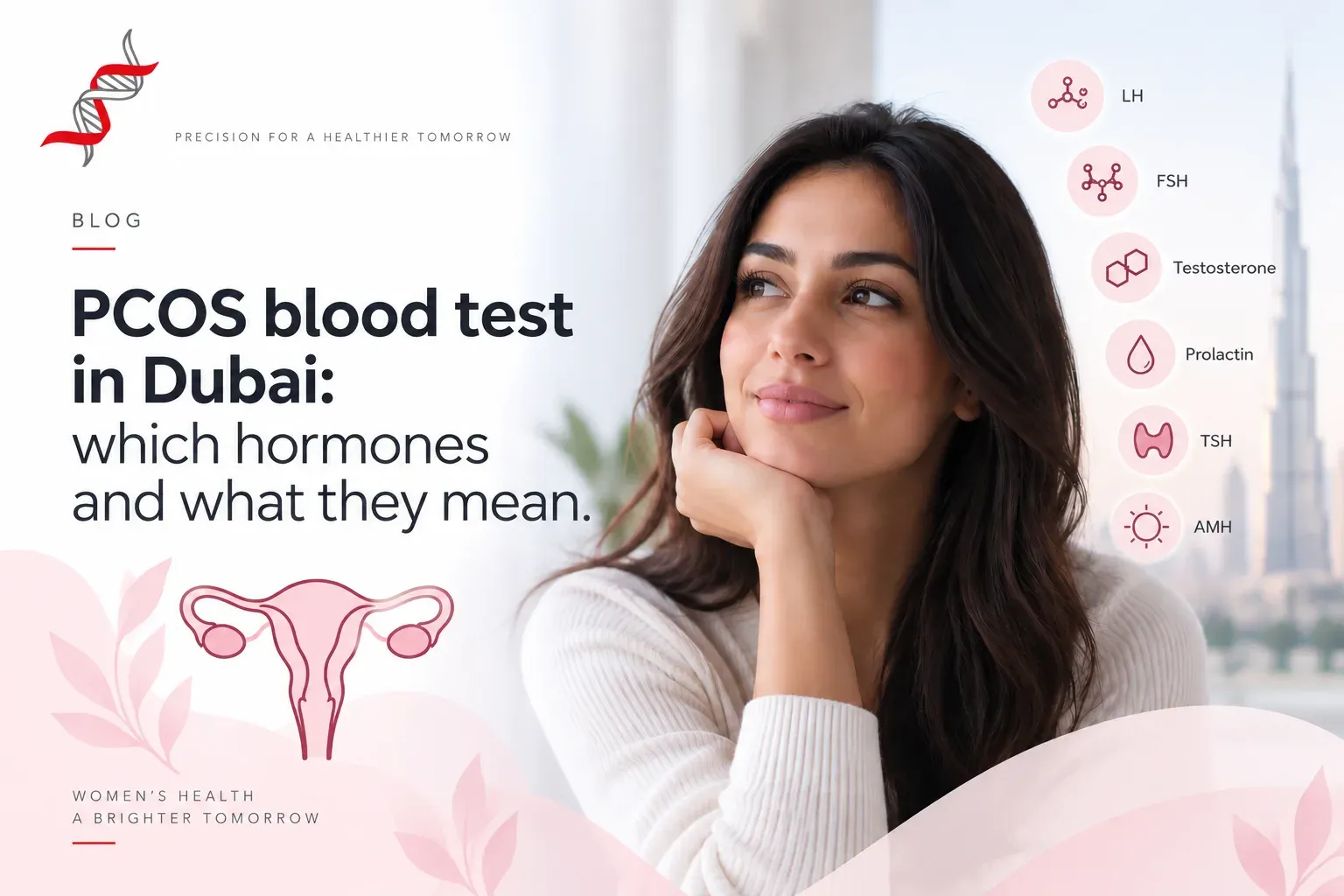
Whatever name you were given, the blood tests are the same. Our PCOS profile covers 16 markers from one blood draw: total testosterone; FSH, LH, estradiol and progesterone; TSH, free T3, free T4 and prolactin; and HbA1c, fasting glucose and five lipid markers. It costs AED 499 with home collection included, and results take up to 72 hours.
The first step if a period is late and pregnancy is possible.
What we do not offer. Androstenedione, which the guideline lists alongside DHEA-S, and 17-hydroxyprogesterone are not on our menu; if your doctor wants them, they can arrange them. We also do not provide ultrasound, which is an imaging test rather than a blood test.
How androgen results are read. The guideline sets a high standard for measuring testosterone in women, favouring highly accurate mass spectrometry methods over direct immunoassays, and notes that reference ranges vary widely between laboratories.4 Your result should be interpreted against the reporting laboratory's own range by the reviewing physician.
Insulin tests. You may see fasting insulin or HOMA-IR suggested for PCOD. The guideline recognises insulin resistance as part of the condition, but says currently available insulin tests are of limited clinical value and are not recommended in routine care.4
Other packages. If you are comparing options, Hormones Profile (Female) and Female Fertility are not substitutes: neither includes the thyroid, glucose and cholesterol markers in the PCOS profile.
Before you book
Cycle timing. If your cycles are regular, some hormones are best measured on particular days; our PCOS blood test guide explains which. If they are irregular or absent, book when it suits you and tell us when your last period was.
Fasting. The PCOS profile includes fasting glucose and a lipid profile, so plan on 10 to 12 hours without food; plain water is fine.
The contraceptive pill. The combined pill makes androgen results unreliable and may lower AMH. If an androgen assessment is essential, the guideline advises stopping the pill for at least three months, using other contraception meanwhile.4 Never stop it for a blood test without speaking to your doctor first, and mention any hormonal contraception when you book.
A late period. If there is any chance you could be pregnant, a pregnancy test comes first.
Samples are collected at home, anywhere in Dubai, seven days a week between 7am and 10pm, and every report is reviewed by a physician.
"I was told I have PCOD." What to do next
A label on its own tells you less than it seems. These questions help turn it into a clear plan with your doctor:
Which of the three features do I have, and how was each one assessed?
Were thyroid disease, high prolactin and other look-alike conditions ruled out?
Was the diagnosis based on a scan alone, and do I meet the full criteria?
Have my glucose and cholesterol been checked, with which tests, and when should they be repeated?
If I was diagnosed as a teenager, was that based on the adolescent criteria, and should it be reassessed?
Should my mood, sleep or eating habits be assessed as part of my care?
Normal results do not always mean nothing is wrong. If your results are within range but your periods are still irregular or your symptoms persist, that is still useful information: it narrows down the causes and points your doctor to the next question.
An abnormal result does not confirm the diagnosis on its own. A single raised hormone is a finding to interpret alongside your history and examination, which is why results should always be read by a licensed physician.
If the label has worried you, that is understandable, and it is a reasonable thing to raise with your doctor. Do not start, stop or change any medication, including hormonal contraception, because of a label or a single result. And if children are part of your plans, the guideline's message is reassuring: pregnancy can often be achieved, naturally or with medical help.4
Book the PCOS panel
Sixteen markers, one blood draw, a nurse who comes to you anywhere in Dubai, and a physician who explains what the numbers mean, whichever name is on your report. Book the PCOS panel, or ask a clinician first if you are not sure where to start.
This article is for general education and is not a substitute for medical advice. PCOS, PCOD or PMOS cannot be diagnosed from an ultrasound or a blood test alone and should be assessed by a licensed physician who can take your full history. Intel Lab Diagnostics is licensed by the Dubai Health Authority (licence 0046381) and accredited by EIAC to ISO 15189:2022. Prices and turnaround times were verified on 15 September 2026.
Helpful? Let us know
Was this helpful?
Laboratory tests
Related tests you can book
Health package
Polycystic Ovary Syndrome (PCOS)
A dedicated panel of hormonal, thyroid, lipid and metabolic markers to support the assessment of PCOS.
From 499
Blood test
Anti-Müllerian Hormone (AMH)
Anti-Müllerian Hormone is produced by the small developing follicles in the ovaries, so the amount in your blood tracks the size of the egg pool you…
From 240
Blood test
Glucose Tolerance Test (GTT, 75 Grams)
The 75g GTT measures your body's ability to handle a glucose load. Blood sugar is measured fasting and at 1 and 2 hours after drinking 75 grams of…
From 179
Blood test
Sex Hormone Binding Globulin (SHBG)
SHBG is a protein that binds and carries sex hormones in the blood. Low SHBG increases free testosterone and is associated with PCOS, insulin…
From 319
Blood test
Dehydroepiandrosterone Sulphate (DHEA-S)
DHEA-S is a hormone produced by the adrenal glands that serves as a precursor to sex hormones. Abnormal levels may indicate adrenal tumours, PCOS, or…
From 120
Health package
Pregnancy Blood Test
Confirm pregnancy early and accurately with a quantitative Beta hCG blood test — detectable sooner and more reliable than a home urine test.
From 179
FAQ
Frequently Asked Questions
Everything you need to know about our tests and bookings. Can't find what you're looking for?
Yes. They are two names for the same condition. The US National Library of Medicine lists polycystic ovarian disease (PCOD) as another name for polycystic ovary syndrome (PCOS), and the international diagnostic guideline describes a single diagnosis with no separate PCOD. Since May 2026, the condition's new official name is polyendocrine metabolic ovarian syndrome (PMOS).
Neither, because they are not different conditions. The condition varies from person to person, but that variation sits within one diagnosis. The international guideline recommends the same core assessment for everyone diagnosed, including glucose and cholesterol checks, whichever name appears on the report.
PMOS stands for polyendocrine metabolic ovarian syndrome, the new name agreed through a global consensus published in The Lancet in May 2026. Only the name has changed, not the condition. The new name is being introduced over a three-year transition, so reports may say PCOS, PCOD or PMOS for some time, and all three describe the same diagnosis.
Not on the scan alone. Polycystic-looking ovaries are common in women who ovulate normally. In adults, a diagnosis needs at least two of three features: irregular or absent ovulation, signs of androgen excess, and polycystic ovaries on ultrasound or a raised AMH, after other causes have been ruled out. Ultrasound is not recommended for diagnosis within eight years of a first period.
PCOD and PCOS are the same condition, so the answer is the same for both. The international guideline treats the diagnosis as lifelong, while its features can be managed and naturally change at different life stages. A healthy lifestyle has benefits even without weight loss, and your doctor can discuss options for specific symptoms. Be cautious of any product or programme that promises a cure.
Our PCOS profile is AED 499 for 16 markers, with home collection anywhere in Dubai included and a physician-reviewed report. Common additions are AMH (AED 240), SHBG (AED 319), DHEA-S (AED 120) and the 75g glucose tolerance test (AED 179), depending on what your doctor needs.
Yes. The panel includes fasting glucose and a lipid profile, so plan on 10 to 12 hours without food; plain water is fine. The 75g glucose tolerance test also requires fasting. If you use hormonal contraception, mention it when you book, because it affects how some results are read.
The PCOS profile reports within 72 hours as a physician-reviewed digital report. AMH takes 2 to 3 days, while SHBG, DHEA-S, the 75g glucose tolerance test and the pregnancy blood test each take 24 hours.
References & Sources
This article cites peer-reviewed research and guidance from recognised medical authorities.
Specialisation: Clinical PathologyDHA Reg. No. 65077850-00725+ years experience
Dr Nirupama Sabhapathy is a DHA-licensed Specialist in Clinical Pathology and Lab Director at Intel Lab, Dubai. She oversees laboratory operations and quality assurance across every testing panel, and each abnormal result passes a specialist review before it reaches you.
D
Written by
Dr Nirupama Sabhapathy
Clinical Writer · Intel Lab Health Editorial
Dr Nirupama Sabhapathy is a DHA-licensed Specialist in Clinical Pathology and Lab Director at Intel Lab, Dubai. She trained at the Manipal Academy of Higher Education and holds the DNB in Pathology from the National Board of Examinations, New Delhi.