TSH Test in Dubai: High vs Low TSH, Free vs Total T4 and T3
What TSH, free and total T4 and T3, and thyroid antibodies measure, what a high or low result can and cannot tell you, and how to prepare. From AED 35.
Medically Reviewed Evidence Based 13 min read·Updated 10 October 2026
DHA
DHA Compliant
Dubai Health Authority
EIAC
EIAC Accredited
ISO 15189:2022
13 min
Reading time
Medically Reviewed
Medically reviewed
Oct 2026
Last updated
6 sources
Evidence cited
On this page
Key Takeaways
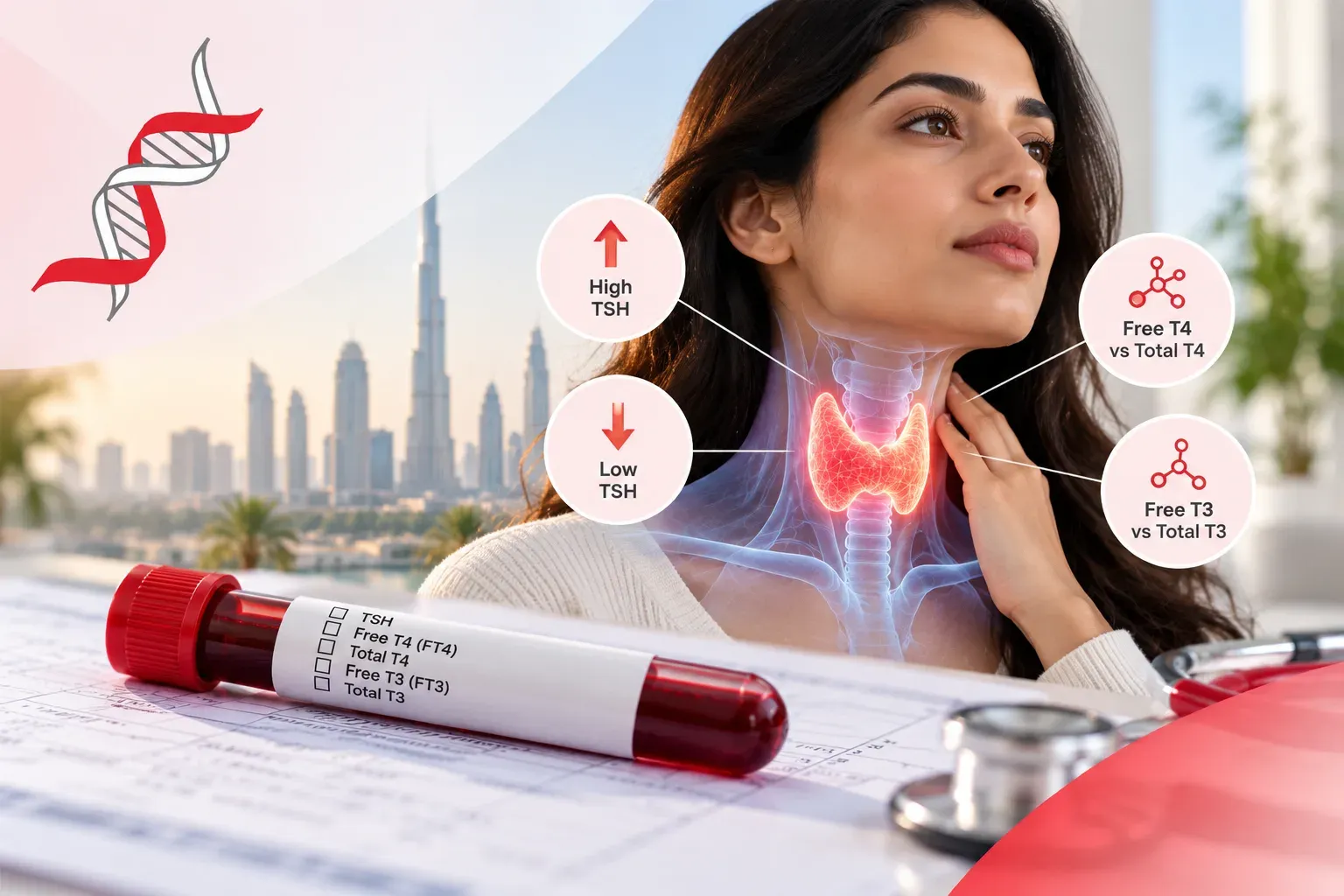
A high TSH usually points to an underactive thyroid and a low TSH to an overactive one, because TSH is the pituitary's signal and moves in the opposite direction to thyroid hormone. TSH alone cannot tell you how far the hormones have moved or why, which is what free T4 and free T3 are for.
The Thyroid Function package measures TSH, free T4 and free T3 for AED 199, with no fasting, home collection anywhere in Dubai included and results in 24 hours. TSH alone is AED 35, but a test booked without a package carries a collection fee, so for home collection the package costs less than the same three tests booked separately (AED 205).
A single mildly raised TSH is usually repeated before anything is decided. European guidance recommends rechecking TSH and free T4 with TPO antibodies, preferably after 2 to 3 months, and NICE uses a TSH of 10 mU/L or higher on two occasions three months apart as the point at which treatment is considered.
Total T4 rises in pregnancy and with oestrogen because carrier proteins rise, so free T4 is the standard T4 test. For T3 the preference is reversed: the American Thyroid Association notes that total T3 is frequently preferred because free T3 assays are less robust.
High-dose biotin, widely sold for hair, skin and nails, can give a falsely low TSH and a falsely high free T4 that look like an overactive thyroid. Tell us if you take it, and ask your doctor before pausing any supplement or medicine.
Most people expect a high thyroid result to mean an overactive thyroid. With TSH it is usually the other way round, and that one misunderstanding causes a great deal of unnecessary worry. The next questions follow quickly: whether TSH on its own is enough, and whether you need free or total hormones.
This guide explains what each thyroid test measures, what a high or low TSH can and cannot tell you, how to prepare, and what each option costs.
Important: This article is for general education and does not replace medical advice. Laboratory results should always be interpreted by a licensed physician in the context of your individual history and examination.
Related package
Thyroid Function
TSH, FT4 and FT3 from one blood sample, to check for an underactive or overactive thyroid.
Starting at
199
Start here: TSH is the first test, not the whole answer
TSH (thyroid stimulating hormone) is not made by the thyroid. It is made by the pituitary gland at the base of the brain, and it is the signal that tells the thyroid how hard to work. When thyroid hormone levels fall, the pituitary releases more TSH. When they rise, it releases less. So a high TSH usually points to an underactive thyroid, and a low TSH usually points to an overactive one.
The relationship is also very sensitive. A small change in free thyroxine (free T4) produces a large change in TSH, which is why TSH picks up thyroid hormone excess earlier than direct hormone measurements do, and why it has the highest sensitivity and specificity of any single blood test for a suspected overactive thyroid.1
That sensitivity is also its limit. TSH tells you that something has moved, not how far the thyroid hormones have moved, or why. That is the job of the other tests:
The UK's National Institute for Health and Care Excellence (NICE) suggests TSH alone as the first test for adults when pituitary disease is not suspected, then adding free T4 if TSH is high, and free T4 and free T3 if TSH is low.2
When pituitary disease is suspected, NICE suggests measuring TSH and free T4 together from the start, because TSH can look misleadingly normal when the pituitary itself is the problem.2
Laboratories that keep the sample and automatically add free T4 and T3 when TSH is abnormal avoid a second blood draw.1 Booking all three markers together does the same thing, and that is how our Thyroid Function package is built.
What each thyroid test measures
Thyroid hormones travel in the blood mostly attached to carrier proteins. Only the unbound, or free, fraction is available to the body's tissues. Total tests measure bound and free hormone together, so they are affected by changes in those proteins.1
Test
What it measures
When it earns its place
Price
Thyroid Stimulating Hormone (TSH)
The pituitary's signal to the thyroid
The first-line screen
AED 35
Thyroxine, Free (FT4)
Unbound T4, the main hormone the thyroid releases
Confirms and grades a high or low TSH
AED 35
Tri-Iodothyronine, Free (FT3)
Unbound T3, the active form of the hormone
A low TSH or a suspected overactive thyroid
AED 35
Thyroxine, Total (T4)
Bound and free T4 together
When your doctor specifically asks for it
AED 35
Tri-Iodothyronine, Total (T3)
Bound and free T3 together
Often preferred by specialists for T3
AED 35
Anti-Thyroid Peroxidase Antibody (Anti-TPO)
An antibody that signals autoimmune thyroid disease
A raised TSH, to look for the cause
AED 95
Anti-Thyroglobulin Antibody (Anti-TG)
A second thyroid antibody
Second-line, when a doctor asks for it
AED 95
The Thyroid Function package combines the first three for AED 199, with home collection included, no fasting and results in 24 hours. Individual tests booked without a package carry a collection fee, explained in the prices section below.
Related test
Thyroid Stimulating Hormone (TSH)
TSH is the most sensitive test for thyroid function. Produced by the pituitary gland, it controls thyroid hormone production. High TSH suggests…
Starting at
35
A high TSH: what it can and cannot tell you
High TSH with low free T4 is the pattern of overt primary hypothyroidism, an underactive thyroid.3
High TSH with normal free T4 is called subclinical hypothyroidism.3 The thyroid is still keeping hormone levels in range, but the pituitary is having to push harder to achieve it.
European Thyroid Association guidance divides subclinical hypothyroidism into a mildly raised TSH of 4.0 to 10.0 mU/L and a more clearly raised TSH above 10 mU/L.3 The difference matters, because the two are handled differently.
Why a single raised TSH is usually repeated
A mildly raised TSH often settles without treatment. The European guideline recommends that a first raised TSH with a normal free T4 be checked again, measuring TSH and free T4 together with thyroid peroxidase antibodies, preferably after 2 to 3 months.3 The 2026 American Thyroid Association guideline notes that in older populations, up to 80% of mildly raised TSH results return to normal when measured again.4
NICE uses a TSH of 10 mU/L or higher on two separate occasions three months apart as the point at which treatment for subclinical hypothyroidism is considered.2 That decision belongs to your doctor.
Things that can raise TSH without thyroid disease
Age. TSH tends to drift upwards with age, and European guidance suggests age-specific reference ranges should be considered before diagnosing subclinical hypothyroidism in older people.3
Recent illness. NICE advises against thyroid testing during an acute illness, unless the illness may itself be caused by the thyroid, because the illness can affect the results.2
Interference in the test. Some people carry antibodies, called heterophilic antibodies, that can produce a falsely high TSH. Repeating the test on a different method is one way this is checked.1
A low TSH: what it can and cannot tell you
Low TSH with raised free T4, T3 or both is overt hyperthyroidism, an overactive thyroid. In this situation TSH is usually below 0.01 mU/L on modern assays.1
Low TSH with normal free T4 and T3 is subclinical hyperthyroidism.1
Why free T3 matters when TSH is low
In the early stage of an overactive thyroid, free T4 can still be normal while only T3 is raised, a pattern called T3-toxicosis.1 A panel of TSH and free T4 alone would miss it. This is why NICE suggests adding free T3 when TSH is low,2 and why our standard thyroid package includes it.
A low TSH does not always mean an overactive gland
Thyroid medicine. Taking more thyroid hormone than the body needs can lower TSH, particularly into the subclinical range.1
Pregnancy. The pregnancy hormone hCG stimulates the thyroid, and a TSH below 0.4 mU/L is common in healthy pregnancy, most of all towards the end of the first trimester.4
Inflammation of the thyroid (thyroiditis). An inflamed gland can release stored hormone for a time, including after childbirth. This looks like an overactive thyroid but has a different cause.1
Recovery after treatment. TSH can stay suppressed for a month or longer after an overactive thyroid has settled, so during that time it is read together with free T4 and T3.1
Finding the cause of an overactive thyroid often needs a test we do not offer. TSH receptor antibodies (TRAb) are the key blood test for Graves' disease. In people with an overt overactive thyroid, current TRAb assays have a sensitivity of 96 to 97% and a specificity of 99% for it.1 TRAb is not on our menu. If your doctor needs it, or a thyroid scan or ultrasound, they will arrange it.
On the other side, a normal TSH is strong reassurance. Outside a few rare situations, such as a TSH-producing pituitary tumour or interference in the test, a normal TSH rules out an overactive thyroid.1
Related test
Tri-Iodothyronine, Total (T3)
Total T3 measures all triiodothyronine in the blood, both bound and free forms. It helps evaluate thyroid function, especially in hyperthyroidism…
Starting at
35
Free or total: which hormone test to choose
Because total T4 and total T3 include hormone bound to carrier proteins, anything that changes those proteins changes the total result, even when the thyroid is working normally. The main carrier protein, thyroxine binding globulin, rises in pregnancy, with oestrogen, and in hepatitis.1 In pregnancy it climbs from about week 7 and peaks around week 16, and total T4 rises by about 50% by that point.4 A high total T4 in these situations can be entirely normal for that person.
That is why free T4 is the standard T4 test, and the one in our package.
For T3, the usual preference is reversed. The American Thyroid Association notes that free T3 assays are less widely validated and less robust than free T4 assays, so total T3 is frequently preferred in clinical practice.1 Our standard package uses free T3. If your doctor prefers total T3, Tri-Iodothyronine, Total (T3) is AED 35.
Free hormone tests are not perfect either: in the second half of pregnancy some free T4 methods read falsely low, and TSH remains the best single marker of thyroid status in pregnancy.4
Situation
Usual choice
Why
Routine check of thyroid function
TSH with free T4 and free T3
Free hormones are not affected by carrier protein changes in most people
Pregnancy, or taking oestrogen
TSH and free T4, read against appropriate ranges
Total T4 rises with carrier proteins even when the thyroid is normal
Suspected or treated overactive thyroid
TSH, free T4 and T3, where total T3 is often preferred
Early disease can raise T3 alone
Thyroid antibodies: when Anti-TPO and Anti-TG add something
Thyroid autoimmunity, where the immune system targets the thyroid, is the main risk factor for an underactive thyroid.4 Antibody tests look for that process.
Anti-TPO (thyroid peroxidase antibody) is the main one. It identifies autoimmune hypothyroidism more accurately than Anti-TG and remains the preferred thyroid antibody test.4 NICE suggests considering it for adults whose TSH is above the reference range, and not repeating it once it has been done.2Anti-TPO is AED 95, with results in 24 hours.
Anti-TG (thyroglobulin antibody) is less accurate for this purpose, and is a second-line test that a doctor may add in specific situations.4Anti-TG is AED 95.
What a positive result means. A positive Anti-TPO with a normal TSH and free T4 is not a diagnosis of thyroid disease. It marks a higher chance of the thyroid becoming underactive later, which is a reason for periodic checks rather than treatment on its own.4 For women planning a pregnancy in this situation, the 2026 guideline suggests rechecking TSH and free T4 every 3 to 6 months.4
If your TSH comes back raised, ask your doctor whether to add Anti-TPO. Thyroid tests play a different role in our PCOS guide, where they rule out a condition that can mimic PCOS.
Related test
Thyroxine, Total (T4)
Total T4 measures the total amount of thyroxine (both bound and free) in your blood. While useful, it can be affected by conditions that change…
Starting at
35
Related test
Anti-Thyroid Peroxidase Antibody (Anti-TPO)
Anti-TPO detects antibodies against thyroid peroxidase, an enzyme essential for thyroid hormone synthesis. High levels are strongly linked to…
Starting at
95
Before your blood test: biotin, medicines, illness and pregnancy
No fasting is needed for the Thyroid Function package or for any individual thyroid test. If your thyroid test is part of a larger health checkup, that package may need fasting because of its other markers, so check the fasting note for the package you book.
Biotin: the supplement that can mimic thyroid disease
Biotin (vitamin B7) is widely sold for hair, skin and nail health. At high intakes it interferes with laboratory tests that use biotin-streptavidin technology, which is commonly used to measure thyroid hormones.5 The typical effect is a falsely low TSH and a falsely high free T4, a combination that looks like an overactive thyroid and has led to people being wrongly diagnosed with Graves' disease.1,5 Even a single 10 mg dose has interfered with thyroid tests taken within 24 hours.5
The American Thyroid Association advises that people taking high-dose biotin who show this pattern should stop biotin and have the tests repeated at least 2 days later.1 In practice: check the labels of any hair, skin, nail or multivitamin products, tell us about biotin when you book, and ask your doctor whether to pause it before your test. This matters most if you are booking the Hair Loss Profile, which includes TSH, free T4 and free T3.
Thyroid medicine
Keep taking any thyroid medicine exactly as prescribed, and ask the doctor who manages it whether they want your blood taken before or after that day's dose. Tell us about it when you book. If your symptoms change, NICE suggests repeating thyroid tests no sooner than 6 weeks after the most recent one.2
Pregnancy, planning a pregnancy and fertility treatment
Thyroid results in pregnancy are read against different ranges. Where a laboratory does not have its own pregnancy-specific range, the 2026 American Thyroid Association guideline accepts a TSH range of 0.1 to 4.0 mU/L for the first and second trimesters.4 Tell us if you are pregnant, and have your results interpreted by the doctor caring for your pregnancy.
Ovarian stimulation for fertility treatment changes thyroid results, and the guideline considers it sensible to avoid thyroid testing during stimulation or within 2 weeks of an ovulation trigger.4
A normal menstrual cycle does not meaningfully affect thyroid results, so, unlike the hormones in a PCOS panel, thyroid tests do not need to be timed to your cycle.4
What a thyroid test costs, and which option fits you
Home collection is available anywhere in Dubai, 7 days a week from 6am to 9pm, and every report is physician-reviewed and delivered digitally. Any package includes home collection in its price. Individual tests booked without a package carry a collection fee when the order comes to under AED 300: AED 100 for home collection, or AED 50 at our lab.
The three-marker package is the practical starting point for most adults with a reason to test. It adds free T4 and free T3 from the same sample, so a high or low TSH can be interpreted straight away, and home collection is included. Booked separately for home collection, the same three tests would come to AED 205 (AED 105 plus the AED 100 fee).
TSH alone fits when your doctor has asked only for TSH. Booked on its own, it carries the collection fee.
Not every checkup includes the thyroid. Our Basic Health Checkup (AED 199) and Advanced Health Checkup (AED 299) do not include thyroid tests. The Executive (AED 429), Elite (AED 599) and Master (AED 899) Health Checkups do, as do the PCOS, Obesity, Fitness, Hair Loss and Menopause profiles.
Add-ons such as Total T4 (AED 35), Total T3 (AED 35) and Anti-TG (AED 95) can be booked when your doctor asks for them. If you need a combination the standard panels do not carry, you can build a custom panel marker by marker.
Related test
Anti-Thyroglobulin Antibody (Anti-TG)
Anti-TG measures antibodies against thyroglobulin, a key protein in thyroid hormone production. Elevated levels may suggest autoimmune thyroid…
Starting at
95
Your result is back: what to do next, and who should test
Take it to a doctor. Every report is physician-reviewed, and a clinician can talk you through it.
Everything in range: an overactive thyroid is effectively ruled out.1 If symptoms worsen or new ones appear, the tests can be repeated after at least 6 weeks.2
Mildly abnormal TSH with normal free T4 and T3: usually repeated, as described above, rather than acted on straight away.3
Clearly abnormal results, where TSH and free T4 or T3 are both outside range: book a prompt appointment with your doctor.
How often to repeat
For adults with untreated subclinical hypothyroidism, NICE suggests measuring TSH and free T4 once a year if there are features suggesting underlying thyroid disease, and every 2 to 3 years if there are not.2 For adults with untreated subclinical hyperthyroidism, it suggests measuring TSH every 6 months.2 If you take thyroid medicine, your doctor sets the schedule.
Who should consider testing
NICE suggests considering thyroid tests when there is a clinical suspicion of thyroid disease, while noting that one symptom alone may not point to the thyroid, and in people with depression or unexplained anxiety.2 International pregnancy guidance does not support routine testing of every woman before, during or after pregnancy.4
Book a thyroid test
Three markers, one blood draw, no fasting, a nurse who comes to you anywhere in Dubai, and results in 24 hours with a physician-reviewed report. Book the Thyroid Function package, or ask a clinician first if you are not sure which test you need.
This article is for general education and is not a substitute for medical advice. Do not start, stop or change thyroid medicine or supplements on the basis of a single result or this page; speak to your doctor first. Intel Lab Diagnostics is licensed by the Dubai Health Authority (licence 0046381) and accredited by EIAC to ISO 15189:2022. Prices and turnaround times were verified on 10 October 2026.
Helpful? Let us know
Was this helpful?
Laboratory tests
Related tests you can book
Health package
Thyroid Function
TSH, FT4 and FT3 from one blood sample, to check for an underactive or overactive thyroid.
From 199
Blood test
Thyroid Stimulating Hormone (TSH)
TSH is the most sensitive test for thyroid function. Produced by the pituitary gland, it controls thyroid hormone production. High TSH suggests…
From 35
Blood test
Anti-Thyroid Peroxidase Antibody (Anti-TPO)
Anti-TPO detects antibodies against thyroid peroxidase, an enzyme essential for thyroid hormone synthesis. High levels are strongly linked to…
From 95
Blood test
Tri-Iodothyronine, Total (T3)
Total T3 measures all triiodothyronine in the blood, both bound and free forms. It helps evaluate thyroid function, especially in hyperthyroidism…
From 35
Blood test
Thyroxine, Total (T4)
Total T4 measures the total amount of thyroxine (both bound and free) in your blood. While useful, it can be affected by conditions that change…
From 35
Blood test
Anti-Thyroglobulin Antibody (Anti-TG)
Anti-TG measures antibodies against thyroglobulin, a key protein in thyroid hormone production. Elevated levels may suggest autoimmune thyroid…
From 95
FAQ
Frequently Asked Questions
Everything you need to know about our tests and bookings. Can't find what you're looking for?
Usually that the thyroid is underactive, because TSH is the pituitary's signal and rises when thyroid hormone falls. Free T4 shows whether the pattern is overt (low free T4) or subclinical (normal free T4). A single mildly raised result is usually repeated: European guidance recommends rechecking TSH and free T4 with TPO antibodies, preferably after 2 to 3 months. Age, recent illness and interference in the test can also raise TSH.
Usually that the thyroid is overactive, or that the dose of thyroid medicine is more than the body needs. Free T4 and T3 show how significant it is. A low TSH can also be normal in pregnancy, can follow inflammation of the thyroid, and can be caused falsely by high-dose biotin. Finding the cause may need a TSH receptor antibody test, which we do not offer.
Free T4 in almost all cases. Total T4 rises when carrier proteins rise, as in pregnancy, with oestrogen-containing medicines and in hepatitis, even when thyroid function is normal. For T3 the preference is reversed: the American Thyroid Association notes that total T3 is frequently preferred because free T3 assays are less robust. Our package uses free T3, and Total T3 is available for AED 35 if your doctor prefers it.
TSH alone is AED 35 and Anti-TPO is AED 95. The Thyroid Function package, with TSH, free T4 and free T3, is AED 199 with home collection anywhere in Dubai included. Tests booked without a package carry a collection fee when the order comes to under AED 300 (AED 100 at home, AED 50 at our lab), so for home collection the package costs less than the same three tests booked separately (AED 205). Every report is physician-reviewed and delivered digitally.
No. Neither the Thyroid Function package nor any individual thyroid test needs fasting. Larger health checkups that include thyroid markers may need fasting because of their other tests. Tell us when you book if you take biotin or thyroid medicine, or if you are pregnant.
24 hours for the Thyroid Function package and for each individual thyroid test, including Anti-TPO, delivered as a physician-reviewed digital report.
Yes. High-dose biotin interferes with many thyroid tests and can give a falsely low TSH and a falsely high free T4, which looks like an overactive thyroid. Even a single 10 mg dose has interfered with thyroid tests taken within 24 hours. Tell us when you book, and ask your doctor whether to pause it before the test.
No. TSH receptor antibodies, the key blood test for Graves' disease, are not on our menu. If your doctor needs TRAb, or a thyroid scan or ultrasound, they will arrange it.
References & Sources
This article cites peer-reviewed research and guidance from recognised medical authorities.
Specialisation: Clinical PathologyDHA Reg. No. 65077850-00725+ years experience
Dr Nirupama Sabhapathy is a DHA-licensed Specialist in Clinical Pathology and Lab Director at Intel Lab, Dubai. She oversees laboratory operations and quality assurance across every testing panel, and each abnormal result passes a specialist review before it reaches you.
Dr Nirupama Sabhapathy is a DHA-licensed Specialist in Clinical Pathology and Lab Director at Intel Lab, Dubai. She trained at the Manipal Academy of Higher Education and holds the DNB in Pathology from the National Board of Examinations, New Delhi.