Medically Reviewed Evidence Based 12 min read·Updated 14 October 2026
DHA
DHA Compliant
Dubai Health Authority
EIAC
EIAC Accredited
ISO 15189:2022
12 min
Reading time
Medically Reviewed
Medically reviewed
Oct 2026
Last updated
6 sources
Evidence cited
On this page
Key Takeaways
No test detects an infection immediately. For HIV, a laboratory antigen/antibody test on blood from a vein can usually detect the virus 18 to 45 days after exposure, so a negative result taken earlier than that should be repeated.
Intel Lab's STD packages run from AED 199 (STD Essentials) to AED 999 (STD Master 28), and every package includes home collection anywhere in Dubai, 7 days a week, from 6am to 9pm.
Blood tests and PCR panels answer different questions. HIV, hepatitis B, hepatitis C and syphilis (RPR) are checked on blood, while STD Core Screening (STD-7), STD Extended 14 and STD Master 28 are PCR panels run on a urine or swab sample, and the two larger ones also look for herpes and syphilis.
Having no symptoms is not a result. The World Health Organization estimates that more than 1 million curable STIs are acquired worldwide every day, and that most of them cause no symptoms.
CDC advises HIV testing at least once a year if certain risk factors apply, such as more than one sex partner since your last test, and repeat testing after the window period if a test follows a recent exposure.
In Dubai, "at-home STD testing" can mean two quite different things: a kit you use yourself and post to a laboratory, or a nurse who visits you, collects the sample and sends it for testing. The tests also differ in what they look for and in how soon after an exposure they can find it, and many infections cause no symptoms, so feeling well tells you very little.2
This guide explains how home collection works at Intel Lab, which tests use blood, urine or a swab, why timing changes your result, and how to choose between our STD packages.
Important: This article is for general education and does not replace medical advice. Laboratory results should always be interpreted by a licensed physician in the context of your individual history and examination.
Related package
STD Core Screening (STD-7)
A focused 7-target PCR panel for the core bacterial STIs: chlamydia, gonorrhoea, trichomonas, plus mycoplasma and ureaplasma species.
Starting at
399
Start here: when you test matters as much as what you test
Two facts shape everything else in this guide.
First, a lack of symptoms is not a result. The World Health Organization (WHO) estimates that more than 1 million curable sexually transmitted infections (STIs) are acquired every day worldwide by people aged 15 to 49, and that most of them cause no symptoms.3 The UK National Health Service (NHS) makes the same point: you can have an STI without knowing it, and the only way to know for sure is to get tested.2 Our guide to STD symptoms in men and women explains why testing without symptoms matters.
Second, no test detects an infection immediately. Every test has a window period, which is the time between exposure and the point at which the test can detect the infection in your body.1 The NHS advises that STIs can take up to 7 weeks after unprotected sex to show up on a test, and that if you have no symptoms it is best to wait 7 weeks before testing.2 The exact timing depends on the infection and on the test, which is why the sections below separate them.
A sensible plan therefore has two parts. Choose a test that looks for the infections you are concerned about, and think about when the sample is taken in relation to the exposure. A negative result taken too early is a reason to test again, not a reason to stop.
What "at-home" means at Intel Lab
Some services post a self-sampling kit to your address, which you return to a laboratory. The NHS describes this route for chlamydia and for syphilis, for example.45
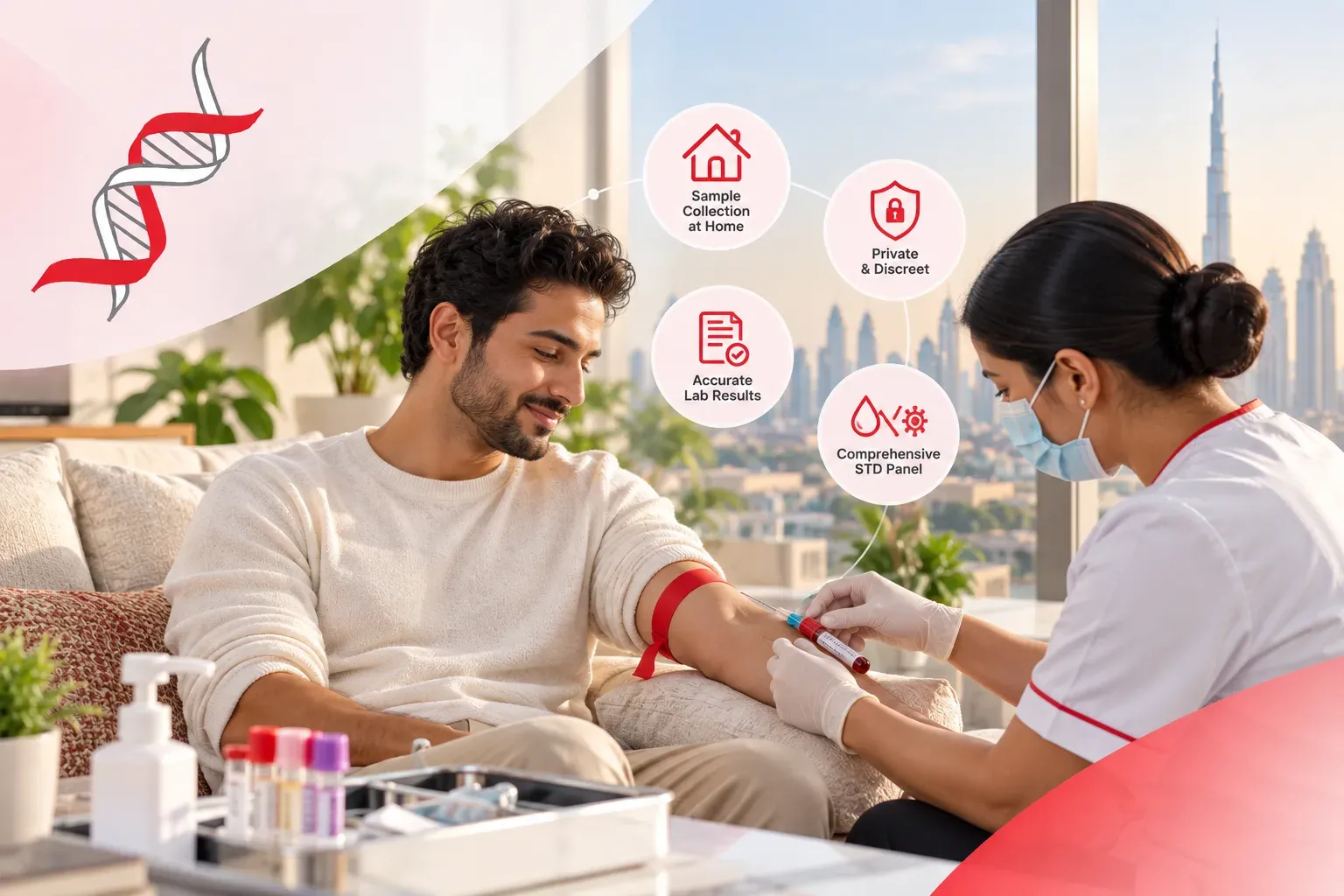
Intel Lab works differently. A nurse comes to your home, office or hotel anywhere in Dubai, 7 days a week, from 6am to 9pm. Home collection is free with any package; a test booked on its own, without a package, carries a collection fee, which is shown before you pay.
You book the test yourself, with no referral letter and no consultation to sit through, and the appointment stays under your name alone. A physician reviews your result before it reaches you, and it arrives as a secure digital Smart Report.
Many people choose home collection because they would rather not sit in a clinic waiting room. That is a reasonable preference and it needs no explanation. Intel Lab Diagnostics is licensed by the Dubai Health Authority (licence 0046381) and accredited by EIAC to ISO 15189:2022.6
There is one more difference between a self-test and a laboratory test that is worth knowing. CDC notes that most rapid tests and HIV self-tests are antibody tests, which can usually detect HIV 23 to 90 days after exposure.1 The HIV test in our STD packages also measures P24 antigen, a part of the virus itself that can be detected before antibodies develop.1 The window period section below shows what that means in days.
Related package
STD Extended 14
A 14-target PCR panel screening for the most common sexually transmitted and genital-tract infections from a single sample, including chlamydia,…
Starting at
499
How a home collection visit works
Choose a package and book your visit. Pick a package from the table below, or build a custom panel marker by marker. Visits run 7 days a week, from 6am to 9pm.
No fasting is needed. None of the STD packages in our catalogue require fasting.
The sample depends on the package. It is a blood sample, a urine sample or a swab. If your package uses a swab, the nurse can take it, or you can ask to take it yourself and the nurse will give you instructions. The next section shows which package uses which sample.
Your report arrives digitally. It is reviewed by a physician. Every STD package reports within 24 to 48 hours, as set out in the package table below.
If you are unsure how a particular sample is collected, or want to know what to expect on the day, ask a clinician before you book.
Blood, urine or swab: which sample for which infection
Our STD tests fall into two families. Blood tests look for the body's response to an infection, or for a part of the organism itself, in a serum sample. PCR panels are molecular tests: they look for the genetic material of the organisms on the panel, in a urine or swab sample.
Sample
Tests in our catalogue
What they look for
Blood (serum)
HIV 1 & 2 Antibodies with P24 Antigen (AED 150); Hepatitis B Surface Antigen (HBsAg) (AED 55); Hepatitis C Antibody (Anti-HCV) (AED 75); RPR (Rapid Plasma Reagin) (AED 55); Treponema Pallidum Hemagglutination Assay (TPHA) (AED 105)
The split matters because the same infection can be looked for in different ways. For chlamydia, for instance, the NHS describes testing with a urine sample or a swab, and notes that most people who have chlamydia have no symptoms.4 For syphilis, the NHS describes a blood sample, with a swab taken from any sores if they are present.5 WHO also notes that molecular tests are especially useful for diagnosing infections that cause no symptoms.3
STI-14 adds herpes simplex virus types 1 and 2, syphilis (Treponema pallidum), Haemophilus ducreyi, Candida albicans, Gardnerella vaginalis and Group B Streptococcus.
STI-28 covers the STI-14 organisms except Group B Streptococcus, and adds cytomegalovirus, lymphogranuloma venereum, varicella zoster virus, six further Candida species, Lactobacillus species, and Mobiluncus, Megasphaera type 1, Atopobium vaginae, Bacteroides fragilis and bacterial vaginosis-associated bacterium 2 (BVAB-2).
WHO groups the main sexually transmitted infections into four that are generally curable (syphilis, gonorrhoea, chlamydia and trichomoniasis) and four viral infections (hepatitis B, herpes simplex virus, HIV and human papillomavirus).3 None of our STD packages covers all eight. STD Advanced 20 comes closest, with seven of them, and HPV is a separate test. That is why choosing a package starts with knowing what each one includes.
Related test
RPR (Rapid Plasma Reagin)
RPR is a screening test for syphilis that detects antibodies to tissue damage caused by the bacterium Treponema pallidum. A positive result requires…
Starting at
55
Window periods: why testing too early can miss an infection
The clearest published window periods are for HIV, so they make a good worked example. CDC gives these usual detection times after exposure for each type of HIV test:1
Type of HIV test
Usually detects HIV after exposure
Nucleic acid test (NAT), on blood from a vein
10 to 33 days
Antigen/antibody laboratory test, on blood from a vein
18 to 45 days
Rapid antigen/antibody test, on a finger-stick blood sample
18 to 90 days
Antibody test (including most rapid tests and self-tests)
23 to 90 days
Our HIV test, HIV 1 & 2 Antibodies with P24 Antigen, is run on a serum sample. It is an antigen/antibody laboratory test, so the second row of the table is the one that applies.
What follows in practice is straightforward. If you test after a possible exposure and the result is negative, CDC advises testing again after the window period for the type of test you took.1 A negative result before day 18 tells you very little. A negative result after day 45 with no further exposure is far more informative.
For other infections, the window depends on the organism and the method, and this article does not state figures for them. The NHS gives a general rule of up to 7 weeks for STIs to show up on a test.2 Tell the reviewing physician when the exposure happened, so that your report can be read with the timing in mind.
Related test
HIV 1 & 2 Antibodies with P24 Antigen
This fourth-generation HIV test detects both HIV antibodies and the p24 antigen, enabling earlier detection than antibody-only tests: typically…
Starting at
150
Choosing a package
All prices are in AED and include home collection in Dubai. None of these packages requires fasting.
If your concern is HIV or hepatitis, the blood-based packages are the ones that test for them. STD Essentials covers HIV and hepatitis B. STD Basic Screening adds hepatitis C and syphilis (RPR).
If your concern is the infections that PCR panels detect, the three PCR packages differ in how many organisms they include. STD Extended 14 and STD Master 28 add herpes and syphilis to the STI-7 organisms. The PCR-only packages (STD Core Screening, STD Extended 14 and STD Master 28) do not include the HIV or hepatitis blood tests, so check the contents before you book.
If you want both families in one visit, STD Advanced 20 combines the four Basic Screening blood tests with the STI-14 PCR panel and a urine analysis. You can also build a custom panel.
HBsAg is the first detectable marker of hepatitis B infection. A positive result indicates active hepatitis B, either acute or chronic. This test is…
Starting at
55
Related package
STD Basic Screening
A confidential 5-in-1 blood screen for the core blood-borne STIs: HIV (1 & 2), hepatitis B, hepatitis C and syphilis.
Starting at
299
What a result can and cannot tell you
A laboratory result answers a narrow question: was this infection, or the body's response to it, detected in this sample on this day? What it means for you depends on timing, your history and an examination, which is why every report is reviewed by a physician.
A negative result
A negative result is most reassuring when the sample was taken after the window period and there has been no new exposure since. CDC's guidance for HIV is explicit: if you test again after the window period, have no possible exposure during that time and the result is negative, you do not have HIV.1 A physician applies the same reasoning, adapted to each infection, when reading a negative report from any panel.
A positive result
A positive result is not a diagnosis in itself. For HIV, CDC explains that a positive result on an antibody-type test needs a follow-up test, and that in a laboratory setting the follow-up is usually done on the same blood sample.1 For other infections, a physician decides whether confirmation is needed and what follows. Several of the infections these panels look for, including syphilis and chlamydia, are treated with antibiotics, and treatment is always set by a doctor.45
Your result is about you, not your partner
CDC makes a point that is easy to forget: an HIV test result reveals only your own status, and a negative result for you does not mean your partner's result is negative.1 The same is true of every other test in this guide.
One test can lead to another
The NHS notes that people tested for one infection may be offered tests for others at the same time.4 That is the logic behind a panel. If a result raises a new question, your physician may suggest an additional test, and you do not need to treat that as a sign that something has gone wrong.
What these packages do not cover
A panel you understand is worth more than a panel you assume. These are the main gaps.
Herpes (HSV) in the smaller packages. WHO lists herpes simplex virus among the main viral STIs.3 Herpes simplex virus types 1 and 2 are on the STI-14 and STI-28 PCR panels, so STD Extended 14, STD Advanced 20 and STD Master 28 include them. STD Essentials, STD Basic Screening and STD Core Screening (STD-7) do not.
HPV. Human papillomavirus is not on any of our STD panels. It is a separate test: HPV 32 is AED 999.
HIV nucleic acid testing. CDC explains that a nucleic acid test looks for the virus itself and that it should be considered for people who have had a recent possible exposure and early symptoms, and who have tested negative on an antibody or antigen/antibody test.1 Our catalogue lists HIV 1 PCR Qualitative (AED 549) and HIV 2 PCR Qualitative (AED 549) as separate tests. Whether either suits your situation is a physician's decision, so ask a clinician before you choose.
Symptoms that need a doctor. Home testing is a screening route. If you have symptoms such as unusual discharge, pain when passing urine, sores, blisters or a rash, see a doctor instead of waiting for a panel.2
Your results are back: what to do next, and how often to test
Take your report to a doctor. Every report here is physician-reviewed, and a clinician can explain each result in context. Do not start, stop or change any medicine on the basis of a test report alone.
Think about your recent partners. If an infection is found, your current and recent partners may need testing as well. The NHS notes that sexual health clinics can help with this, and your doctor can advise you on how to approach it.2
If your result was negative but the exposure was recent, ask your physician when to repeat the test. For HIV, that means testing again after the window period for the test you took.1
How often to test. CDC advises that everyone aged 13 to 64 gets tested for HIV at least once, and that people with certain risk factors test at least once a year. Those risk factors include having had more than one sex partner since your last HIV test, having been diagnosed with or treated for another STI, and having had sex with someone whose sexual history you do not know.1 For chlamydia, the NHS advises testing once a year, or when you have a new sexual partner.4 CDC also suggests that before having sex with a new partner, you talk about your sexual history and consider being tested together.1
Book your home STD test
A visit at a time that suits you, anywhere in Dubai, and a physician-reviewed digital report. Book STD Core Screening (STD-7) for AED 399, choose STD Basic Screening for AED 299 if you want blood-based screening for HIV, hepatitis B, hepatitis C and syphilis, or ask a clinician first if you are not sure which package fits.
This article is for general education and is not a substitute for medical advice. A negative result does not rule out a recent exposure, and no test result should lead you to start, stop or change any medicine without a physician's advice. Intel Lab Diagnostics is licensed by the Dubai Health Authority (licence 0046381) and accredited by EIAC to ISO 15189:2022. Prices and turnaround times were verified on 14 October 2026.
Helpful? Let us know
Was this helpful?
Laboratory tests
Related tests you can book
Health package
STD Core Screening (STD-7)
A focused 7-target PCR panel for the core bacterial STIs: chlamydia, gonorrhoea, trichomonas, plus mycoplasma and ureaplasma species.
From 399
Health package
STD Basic Screening
A confidential 5-in-1 blood screen for the core blood-borne STIs: HIV (1 & 2), hepatitis B, hepatitis C and syphilis.
From 299
Health package
STD Extended 14
A 14-target PCR panel screening for the most common sexually transmitted and genital-tract infections from a single sample, including chlamydia,…
From 499
Blood test
HIV 1 & 2 Antibodies with P24 Antigen
This fourth-generation HIV test detects both HIV antibodies and the p24 antigen, enabling earlier detection than antibody-only tests: typically…
From 150
Blood test
RPR (Rapid Plasma Reagin)
RPR is a screening test for syphilis that detects antibodies to tissue damage caused by the bacterium Treponema pallidum. A positive result requires…
From 55
Blood test
Hepatitis B Surface Antigen (HBsAg)
HBsAg is the first detectable marker of hepatitis B infection. A positive result indicates active hepatitis B, either acute or chronic. This test is…
From 55
FAQ
Frequently Asked Questions
Common questions on this topic, answered by our lab team. Can't find yours?
Yes. A nurse comes to your home, office or hotel anywhere in Dubai, 7 days a week, from 6am to 9pm, and home collection is free with any package. Reports are digital and reviewed by a physician.
Intel Lab's STD packages range from AED 199 (STD Essentials) to AED 999 (STD Master 28). STD Basic Screening is AED 299, STD Core Screening (STD-7) is AED 399, STD Extended 14 is AED 499 and STD Advanced 20 is AED 699. Home collection is free with any package. Prices were verified on 14 October 2026.
No. None of the STD packages in our catalogue require fasting.
STD Essentials, STD Basic Screening and STD Master 28 report within 24 hours. STD Core Screening (STD-7), STD Extended 14 and STD Advanced 20 report within 48 hours. Reports are digital and reviewed by a physician.
It depends on the infection and the test. For HIV, CDC says an antigen/antibody laboratory test on blood from a vein can usually detect HIV 18 to 45 days after exposure, which is the type of test in our STD packages. The NHS advises that STIs can take up to 7 weeks to show up on a test. If you test before the window period has passed and the result is negative, test again afterwards.
Possibly. The World Health Organization estimates that most of the more than 1 million curable STIs acquired worldwide each day cause no symptoms, so having no symptoms does not mean you have no infection. A physician can advise whether testing suits your situation.
STD Essentials and STD Basic Screening are blood tests: Essentials covers HIV and hepatitis B surface antigen, and Basic Screening adds hepatitis C antibody and syphilis (RPR). STD Core Screening (STD-7), STD Extended 14 and STD Master 28 are PCR panels on a urine or swab sample, and Extended 14 and Master 28 also look for herpes and syphilis. STD Advanced 20 combines the four blood tests, the STI-14 PCR panel and a urine analysis. If you are unsure, ask a clinician before booking.
Yes, if you prefer. For packages that use a swab, the nurse can take it at the visit, or you can ask to take it yourself and the nurse will give you instructions.
Not always. A negative result means the infection was not detected in that sample at that time. If the sample was taken before the window period ended, the test may not yet be able to detect it, so your physician may advise testing again.
References & Sources
This article cites peer-reviewed research and guidance from recognised medical authorities.
Specialisation: Clinical PathologyDHA Reg. No. 65077850-00725+ years experience
Dr Nirupama Sabhapathy is a DHA-licensed Specialist in Clinical Pathology and Lab Director at Intel Lab, Dubai. She oversees laboratory operations and quality assurance across every testing panel, and each abnormal result passes a specialist review before it reaches you.
Dr Nirupama Sabhapathy is a DHA-licensed Specialist in Clinical Pathology and Lab Director at Intel Lab, Dubai. She trained at the Manipal Academy of Higher Education and holds the DNB in Pathology from the National Board of Examinations, New Delhi.