UAE Visa Medical vs an STD Test: What Each One Screens For
What the UAE visa medical screens for, how it works, and how it differs from a private STD test: blood vs PCR, window periods and results. From AED 199.
Medically Reviewed Evidence Based 9 min read·Updated 21 October 2026
DHA
DHA Compliant
Dubai Health Authority
EIAC
EIAC Accredited
ISO 15189:2022
9 min
Reading time
Medically Reviewed
Medically reviewed
Oct 2026
Last updated
8 sources
Evidence cited
On this page
Key Takeaways
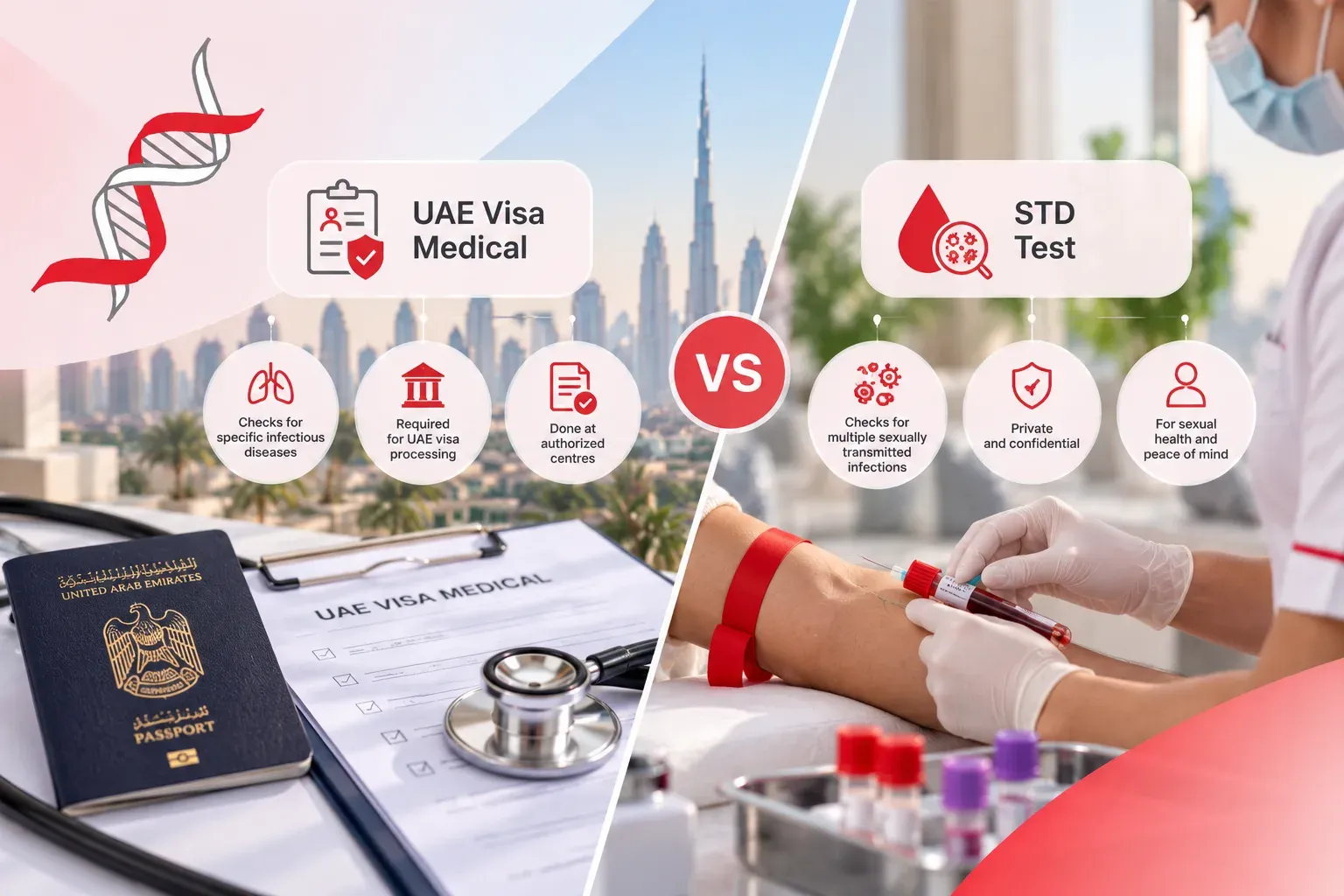
The UAE visa medical screens for HIV, hepatitis B, syphilis, tuberculosis and leprosy, plus a pregnancy test for domestic workers. It is done at government medical fitness centres and issues a fitness certificate for a new or renewed residence visa.
The visa medical is not a sexual health check. Its official list does not include hepatitis C, chlamydia or gonorrhoea, so passing it tells you nothing about those infections.
The sample decides what a test can find. Blood panels test for HIV, hepatitis B, hepatitis C and syphilis, while chlamydia and gonorrhoea need a PCR test on a urine or swab sample. STD Basic Screening covers the four blood tests for AED 299, and PCR panels start at AED 399.
A laboratory HIV antigen/antibody test on blood from a vein usually detects infection 18 to 45 days after exposure, and hepatitis C antibodies appear on average 8 to 11 weeks after exposure, so a negative result taken earlier may need repeating.
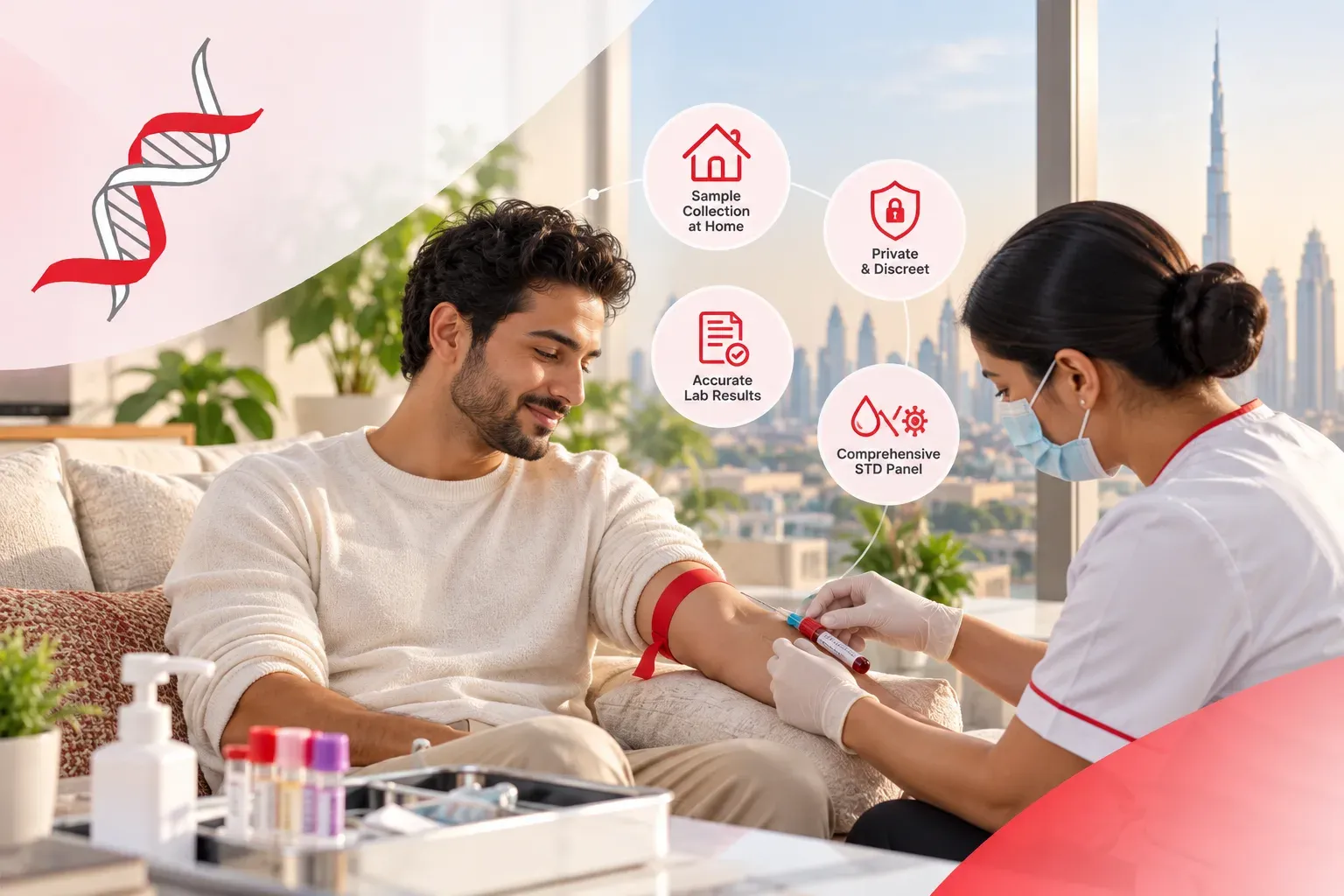
None of the six STD packages needs fasting, home collection anywhere in Dubai is included in the package price, and results take 24 to 48 hours depending on the panel.
If you live in the UAE on a residence visa, you have had a visa medical, and many people leave it believing their sexual health was checked at the same time. It was, but only in part. The visa medical screens for a short, fixed list of infections, and several common ones are not on it.
This guide explains what the visa medical screens for and how it works, what a private STD test measures, why timing after an exposure matters, and how to choose the right panel.
Important: This article is for general education and does not replace medical advice. Laboratory results should always be interpreted by a licensed physician in the context of your individual history and examination.
Related package
STD Basic Screening
A confidential 5-in-1 blood screen for the core blood-borne STIs: HIV (1 & 2), hepatitis B, hepatitis C and syphilis.
Starting at
299
What the UAE visa medical is
The visa medical, officially the medical fitness test, is required to apply for or renew a residence visa. It is carried out at government medical fitness centres and issues a certificate confirming the holder is free from communicable diseases under the approved standards.1 In Dubai, the Dubai Health Authority describes medical fitness screening as a prerequisite for a residency, employment or education visa.2
What it screens for
Under Cabinet Resolution No. 5 of 2016, which amended Cabinet Decree No. 7 of 2008, the UAE government portal lists these tests for people coming to work or live in the UAE:7
HIV, for every residency applicant, new or renewing
Hepatitis B
Syphilis
Tuberculosis (TB)
Leprosy, for new applicants and on renewal
Pregnancy, for domestic workers such as maids, nannies and drivers
The portal states that residency is denied or not renewed for a positive HIV or leprosy result. For drug-resistant TB, the person is treated in the UAE until recovery, after which residency may be renewed.7
How it works
Applicants must be 18 or over. On the Emirates Health Services (EHS) service, you book through UAE PASS, bring a valid Emirates ID or passport and an updated passport photo, and arrive at the centre 20 minutes before your appointment. You then have the laboratory tests and radiology needed for your category, and the report is sent to you electronically; EHS lists the service at 24 hours.1 The fee depends on your occupation category, starting at AED 250 for the medical examination plus the centre's printing fee, with a vaccination fee for some categories on a new application.1
How the visa medical and a private STD test compare
Visa medical
Private STD test at Intel Lab
Purpose
A fitness certificate for a residence visa application or renewal1
Information about your own sexual health
What is tested
HIV, hepatitis B, syphilis, TB and leprosy; pregnancy for domestic workers7
The panel you choose: HIV, hepatitis B, hepatitis C and syphilis on blood, and chlamydia, gonorrhoea and other organisms by PCR
The two overlap on HIV, hepatitis B and syphilis. Hepatitis C, chlamydia and gonorrhoea are not on the visa medical's official list,7 so a recent visa medical tells you nothing about them. And like any test, a visa medical reflects your status on the day of the sample: an infection picked up shortly before it, or at any point since, would not show.
Related package
STD Core Screening (STD-7)
A focused 7-target PCR panel for the core bacterial STIs: chlamydia, gonorrhoea, trichomonas, plus mycoplasma and ureaplasma species.
Starting at
399
What a private STD test measures
Our STD packages fall into two groups: blood tests, and PCR tests on a urine or swab sample. None of them needs fasting, and home collection anywhere in Dubai is included in the package price.
Each PCR panel tests for a fixed list of organisms. STI-7 covers chlamydia, gonorrhoea, trichomonas, Mycoplasma hominis, Mycoplasma genitalium and two Ureaplasma species. STI-14 adds herpes simplex virus types 1 and 2, Treponema pallidum (the cause of syphilis), Haemophilus ducreyi, Candida albicans, Gardnerella vaginalis and Group B Streptococcus. STI-28 keeps the STI-14 list except Group B Streptococcus and adds 15 more, including cytomegalovirus (CMV), lymphogranuloma venereum (LGV), varicella zoster virus, further Candida species and bacteria linked to bacterial vaginosis. If you want to know whether a particular infection is covered before you book, ask a clinician. For a wider look at our panels and how we handle privacy, see our guide to STD test prices and panels in Dubai.
Blood or urine: the sample decides what can be found
This is the single most common gap in STD testing, and it costs nothing to get right.
What a blood panel can find
The blood tests in our STD packages look for HIV, hepatitis B, hepatitis C and syphilis. These infections leave markers in the blood: an antigen, an antibody, or both. STD Essentials covers HIV and hepatitis B; STD Basic Screening adds hepatitis C and syphilis.
What needs a urine or swab sample
Chlamydia and gonorrhoea are not found by a blood test. The CDC guideline names nucleic acid amplification tests (NAATs, the group that includes PCR) as the recommended test for chlamydia, with a vaginal swab for women and first-catch urine for men as the optimal samples, and gives the same optimal samples for gonorrhoea.6 The same guideline notes that chlamydia often causes no symptoms in either men or women, so feeling well is not a reason to assume it is absent.6
Why this matters
A clear blood panel tells you nothing about chlamydia or gonorrhoea, and a clear PCR panel tells you nothing about the HIV, hepatitis or syphilis blood tests. Read the name of the test on your report, not only the word "negative". If you want both kinds of testing in one booking, STD Advanced 20 combines the four blood tests with the STI-14 PCR panel.
Related package
STD Essentials
An essential, confidential blood screen for the infections most people want checked first: HIV (types 1 & 2) and hepatitis B.
Starting at
199
Related package
STD Advanced 20
A 20-marker combined work-up pairing blood serology (HIV, hepatitis B & C, syphilis) with a 14-target genital PCR panel and urinalysis: a complete…
Starting at
699
Timing: when a negative result can be trusted
No test can detect an infection immediately after exposure. The gap between infection and the point at which a test can reliably detect it is called the window period, and it is different for each test.3
Test
What kind of test it is
Usually detectable
HIV 1 & 2 Antibodies with P24 Antigen (in our STD blood packages)
Laboratory antigen/antibody test on blood from a vein
A negative result inside the window is not final. If you had a possible HIV exposure during the window period for the test you took, you need to test again after the window, even if the first result was negative. You can rely on a negative result when your most recent test was after the window period and there has been no new possible exposure since.3
If the possible exposure was in the last 72 hours, the first step is not a blood test. Speak to a healthcare provider as soon as possible about post-exposure prophylaxis (PEP).3
Syphilis needs two kinds of test. A presumptive diagnosis of syphilis uses two blood tests: a nontreponemal test such as RPR and a treponemal test. Using only one type can give false-negative results during primary syphilis.6 Our STD blood packages include RPR, and a treponemal test, TPHA (AED 105), is available separately.
For chlamydia and gonorrhoea, the guideline sections we reviewed do not set a single waiting time after exposure for PCR testing, so we do not give one here. If you are testing after a specific exposure, ask a clinician when to book.
The PCR tests for HIV and hepatitis C are not part of the STD packages. Whether one makes sense for you is a decision for your doctor, based on when and how the possible exposure happened.
Choosing a panel for your situation
Your situation
What to consider
A routine check, with no symptoms and no specific concern
STD Basic Screening (AED 299) covers the four blood infections. For chlamydia and gonorrhoea as well, add a PCR panel or choose STD Advanced 20 (AED 699).
You passed a visa medical and want a fuller picture
The visa medical already covered HIV, hepatitis B and syphilis on the day of the sample. A PCR panel adds chlamydia and gonorrhoea; STD Basic Screening adds hepatitis C and repeats the blood tests if there has been a possible exposure since.
A specific possible exposure in recent weeks
Check the window periods above before booking, so that a negative result means something. Within 72 hours of a possible HIV exposure, speak to a healthcare provider about PEP first.
Symptoms such as discharge, pain when passing urine, sores or a rash
These can be signs of a sexually transmitted infection.6 See a doctor for an examination. A test panel can support that assessment but cannot replace it.
A new relationship, testing together
Booking the same panel for both of you makes the two reports easier to compare.
If you are not sure which panel fits, ask a clinician first. Choosing the right panel matters more than choosing the largest one.
Related test
Treponema Pallidum Hemagglutination Assay (TPHA)
TPHA is a confirmatory test for syphilis that detects specific antibodies against Treponema pallidum. Unlike RPR, once positive, TPHA usually remains…
Starting at
105
Your results are back. What now?
Take them to a doctor. Every report is reviewed by a physician, but a sexual health result means most when it is read alongside your history, your symptoms and the timing of any possible exposure.
A negative result is reassuring when it falls after the window period for that test and there has been no new possible exposure since.3 If either is not true, a repeat test may be needed.
A reactive or positive screening result is not a final diagnosis.
A positive HIV screening test needs follow-up testing to confirm it.3
A reactive RPR can be a false positive, because several other medical conditions can cause one, and syphilis is diagnosed using two different types of test.6 Most people with a reactive treponemal test stay reactive for the rest of their lives, whether or not they were treated, so a reactive treponemal result can reflect a past infection rather than a current one.6
After a positive chlamydia or gonorrhoea result, the CDC guideline advises retesting about 3 months after treatment, because repeat infection is common.6 Treatment itself is a decision for your doctor.
Partners matter too. The same guideline encourages people with a sexually transmitted infection to tell their sexual partners so that they can be checked as well.6 If that conversation feels unsafe or difficult, raise it with your doctor.
Book an STD test
A nurse comes to you anywhere in Dubai, 7 days a week, from 6am to 9pm, with no fasting needed and a physician-reviewed digital report at the end. Book STD Basic Screening for the four blood tests, STD Advanced 20 for blood and PCR together, or ask a clinician first if you are not sure which one you need.
This article is for general education and is not a substitute for medical advice. Intel Lab Diagnostics is licensed by the Dubai Health Authority (licence 0046381) and accredited by EIAC to ISO 15189:2022. Prices and turnaround times were verified on 21 October 2026.
Related test
HIV 1 PCR Qualitative
HIV-1 PCR detects viral RNA in the blood, enabling diagnosis during the window period before antibodies develop. It is the most sensitive test for…
Starting at
549
Helpful? Let us know
Was this helpful?
Laboratory tests
Related tests you can book
Health package
STD Basic Screening
A confidential 5-in-1 blood screen for the core blood-borne STIs: HIV (1 & 2), hepatitis B, hepatitis C and syphilis.
From 299
Health package
STD Advanced 20
A 20-marker combined work-up pairing blood serology (HIV, hepatitis B & C, syphilis) with a 14-target genital PCR panel and urinalysis: a complete…
From 699
Health package
STD Core Screening (STD-7)
A focused 7-target PCR panel for the core bacterial STIs: chlamydia, gonorrhoea, trichomonas, plus mycoplasma and ureaplasma species.
From 399
Health package
STD Essentials
An essential, confidential blood screen for the infections most people want checked first: HIV (types 1 & 2) and hepatitis B.
From 199
Blood test
Treponema Pallidum Hemagglutination Assay (TPHA)
TPHA is a confirmatory test for syphilis that detects specific antibodies against Treponema pallidum. Unlike RPR, once positive, TPHA usually remains…
From 105
Blood test
HIV 1 PCR Qualitative
HIV-1 PCR detects viral RNA in the blood, enabling diagnosis during the window period before antibodies develop. It is the most sensitive test for…
From 549
FAQ
Frequently Asked Questions
Common questions on this topic, answered by our lab team. Can't find yours?
The UAE government portal lists HIV, hepatitis B, syphilis, tuberculosis (TB) and leprosy, plus a pregnancy test for domestic workers such as maids, nannies and drivers. The HIV test applies to every residency applicant, new or renewing, and the portal states that residency is denied or not renewed for a positive HIV or leprosy result. For drug-resistant TB, the person is treated in the UAE until recovery, after which residency may be renewed.
No. The visa medical is a government screening that issues a fitness certificate for a residence visa. A private STD test is a health test you choose for yourself, and you receive a physician-reviewed digital report. The two overlap on HIV, hepatitis B and syphilis, but a private panel can also cover hepatitis C, chlamydia and gonorrhoea, which are not on the visa medical's official list.
You must be 18 or over. You book through UAE PASS, bring a valid Emirates ID or passport and an updated passport photo, arrive at the medical fitness centre 20 minutes before your appointment, and have the laboratory tests and radiology needed for your category. The report is sent to you electronically. On the Emirates Health Services (EHS) service, the medical examination fee starts at AED 250 plus the centre's printing fee, and depends on your occupation category.
STD Essentials is AED 199, STD Basic Screening is AED 299, STD Core Screening (STD-7) is AED 399, STD Extended 14 is AED 499, STD Advanced 20 is AED 699 and STD Master 28 is AED 999. Home collection anywhere in Dubai is included in the package price.
No. None of the six STD packages needs fasting.
It depends on the test. A laboratory HIV antigen/antibody test on blood from a vein usually detects infection 18 to 45 days after exposure. Hepatitis B surface antigen can appear as early as 1 week or as late as 9 weeks (on average about 1 month), and hepatitis C antibodies appear on average 8 to 11 weeks after exposure. If you test inside these windows and the result is negative, you may need to test again. If the possible HIV exposure was in the last 72 hours, speak to a healthcare provider as soon as possible about post-exposure prophylaxis (PEP).
No. Chlamydia and gonorrhoea are tested with a nucleic acid amplification test (such as PCR) on a urine or swab sample, not a blood test. Our STD Core Screening, STD Extended 14, STD Advanced 20 and STD Master 28 packages include a PCR panel.
Results take 24 to 48 hours depending on the panel. STD Essentials, STD Basic Screening and STD Master 28 are listed at 24 hours, and STD Core Screening, STD Extended 14 and STD Advanced 20 at 48 hours.
A reactive screening result is a finding to confirm and interpret, not a final diagnosis. A positive HIV screening test needs follow-up testing to confirm it, and syphilis is diagnosed using two different types of blood test. Your report is physician-reviewed, and a doctor will explain what it means and what to do next.
References & Sources
This article cites peer-reviewed research and guidance from recognised medical authorities.
Specialisation: Clinical PathologyDHA Reg. No. 65077850-00725+ years experience
Dr Nirupama Sabhapathy is a DHA-licensed Specialist in Clinical Pathology and Lab Director at Intel Lab, Dubai. She oversees laboratory operations and quality assurance across every testing panel, and each abnormal result passes a specialist review before it reaches you.
Dr Nirupama Sabhapathy is a DHA-licensed Specialist in Clinical Pathology and Lab Director at Intel Lab, Dubai. She trained at the Manipal Academy of Higher Education and holds the DNB in Pathology from the National Board of Examinations, New Delhi.