Medically Reviewed Evidence Based 10 min read·Updated 29 September 2026
DHA
DHA Compliant
Dubai Health Authority
EIAC
EIAC Accredited
ISO 15189:2022
10 min
Reading time
Medically Reviewed
Medically reviewed
Sep 2026
Last updated
8 sources
Evidence cited
On this page
Key Takeaways
Home kits and blood tests detect the same hormone, hCG. The real differences are sensitivity, timing, and whether you receive a measured value or only a yes or no.
Timing limits every test: in a landmark study, about 10% of pregnancies had not yet implanted on the first day of the missed period, so no hCG test could detect them that day. One week later, the maximum possible detection rose to about 97%.
The Pregnancy Blood Test is AED 159, needs no fasting, includes home collection anywhere in Dubai between 6am and 10pm, and results are ready within 24 hours.
A single hCG result cannot show where a pregnancy is or whether it is progressing. Doctors use two blood results about 48 hours apart, together with ultrasound, to answer those questions.
Sudden severe abdominal pain, heavy bleeding, fainting or shoulder-tip pain in possible early pregnancy need emergency care, not a blood test.
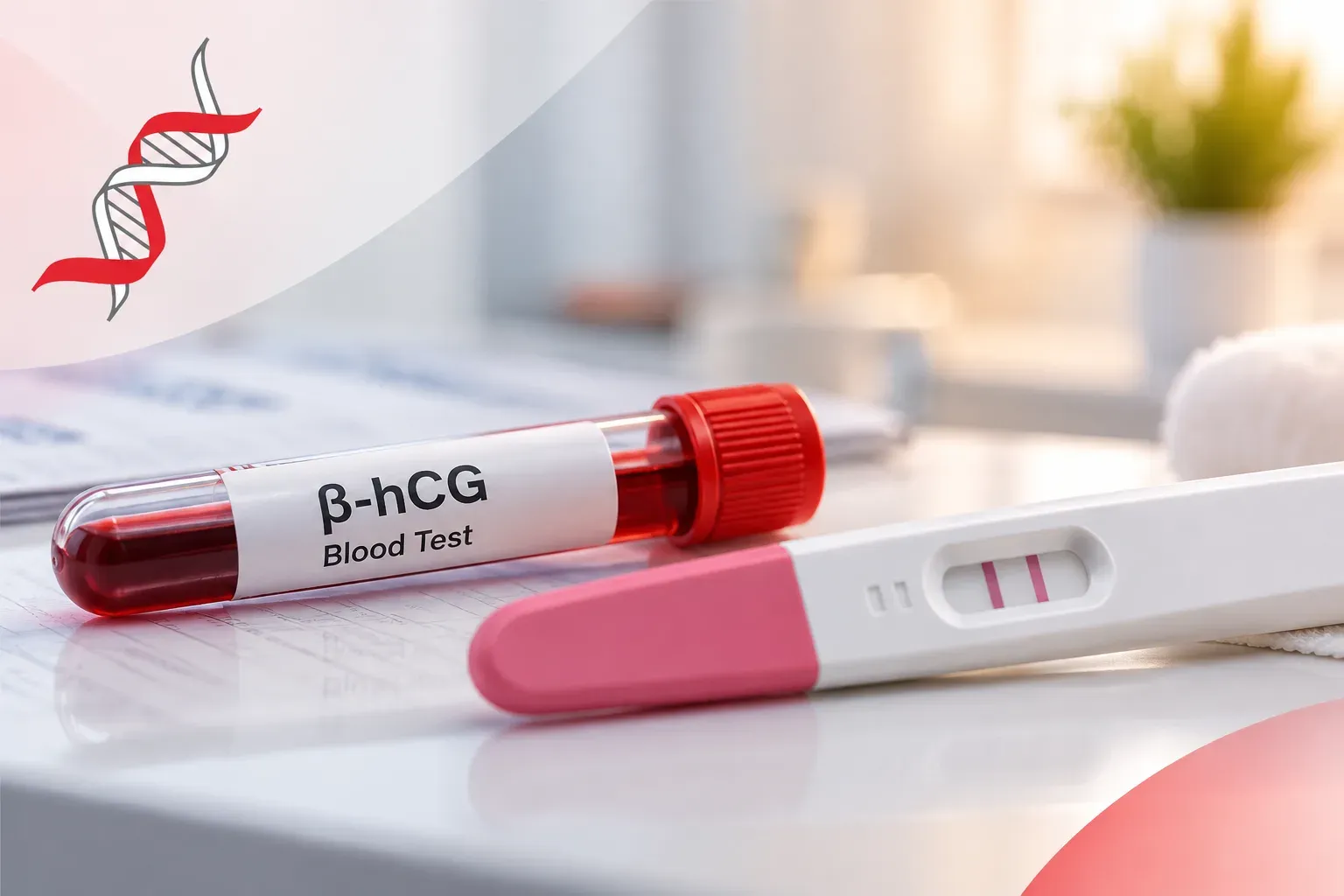
A faint line on a home test, a negative result when your period is late, or a positive result followed by a period: most people looking for a pregnancy blood test are trying to settle a result they do not quite trust. Both tests look for the same hormone, so the useful question is not which one is right, but what each one can detect and when.
This guide explains how a home kit and a laboratory blood test differ, when each becomes reliable, why results sometimes mislead, and what a single hCG result can and cannot tell you.
Important: This article is for general education and does not replace medical advice. Laboratory results should always be interpreted by a licensed physician in the context of your individual history and examination.
Related package
Pregnancy Blood Test
Confirm pregnancy early and accurately with a quantitative Beta hCG blood test: detectable sooner and more reliable than a home urine test.
Starting at
159
Start here: both tests look for the same hormone
Every pregnancy test, whether it is a stick from a pharmacy or a blood sample sent to a laboratory, detects human chorionic gonadotropin (hCG). The body starts making hCG after a fertilised egg implants in the lining of the uterus.3
So the two tests are not measuring different things. They differ in three practical ways:
Sensitivity. A quantitative blood test can find much smaller amounts of hCG than most home kits, which means it can detect a pregnancy earlier.3
The kind of answer. A home kit gives a yes or no. A quantitative blood test gives a measured value that a doctor can follow over time.
Timing. No test, however sensitive, can detect a pregnancy before implantation has happened. Timing matters more than most people realise, and it is covered in detail below.
After a missed period, a home test used correctly is a reasonable first step for most people. A blood test earns its place when the home result is unclear, when it is very early, or when a doctor needs a number rather than a line.
If you would rather not visit a clinic, a nurse can collect the blood sample at your home at a time you choose, and the result comes to you as a physician-reviewed digital report.
What hCG is and when it appears
hCG is made by the tissue that will become the placenta. Implantation usually happens about 10 days after conception, and hCG begins to build up from that point.3 It enters the blood first and reaches the urine in detectable amounts a little later, which is why a blood test can pick up a pregnancy earlier: typically about 10 days after conception for a blood test, compared with two weeks or more for a urine test.3
The complication is that implantation does not happen on the same day for everyone. Ovulation varies from cycle to cycle, and so does the time it takes for a fertilised egg to implant. In a well-known study that tracked hCG daily in women trying to conceive, about 10% of pregnancies had not yet implanted on the first day of the missed period. The researchers calculated that even a perfect hCG test could detect at most 90% of pregnancies on that day, rising to about 97% one week later.1
This is the single most useful fact in this article. A negative result on the day your period is due does not mean the test failed. It may simply be too early for any test to see.
Home kit sensitivity varies more than the packaging suggests. In a 2004 laboratory comparison of 18 home test brands, the researchers estimated that a kit would need to detect 12.5 mIU/mL of hCG to pick up 95% of pregnancies at the time of the missed period, and only one of the 18 brands reached that sensitivity.2 Brands have changed since then, but the lesson holds: an early negative result on a home kit is weaker evidence than it looks.
If your cycles are irregular, you may not know when your period is due. One practical rule is to test about 36 days after the start of your last period, or about four weeks after you had sex, when hCG should be high enough to detect if you are pregnant.3
For a home kit to work as intended: check the expiry date, follow the instructions for your brand exactly, including the reading time, and use your first urine of the morning if you are testing early.3 If the control line does not appear, the test has not worked and should be repeated.3
Why a pregnancy test result can mislead
A negative result when you are pregnant
This is the more common error, and it almost always comes down to timing. Testing before implantation, testing with diluted urine later in the day, or using a less sensitive kit can all give a negative result in early pregnancy.3 If you still think you may be pregnant, repeat the test in a few days or arrange a blood test.3
A positive result that does not lead to an ongoing pregnancy
A positive test followed by a period is distressing, and it is common. In the same research programme that used very sensitive daily hCG testing, 22% of pregnancies ended before they would have been recognised clinically, often around the time of the expected period. Of the women who had one of these early losses, 95% went on to have a clinical pregnancy within two years.4 Earlier generations of tests simply missed these pregnancies. Modern sensitive tests find them.
A positive result when you are not pregnant
True false positives are uncommon, but they have recognised causes:
Fertility medicines that contain hCG. Some fertility treatments use hCG itself, which a pregnancy test cannot tell apart from hCG made by a pregnancy.3 If you are having fertility treatment, follow your fertility clinic's advice on when to test.
Interfering antibodies. Some people carry antibodies that interfere with laboratory hCG assays and produce a falsely raised blood result.5
Around menopause. In perimenopausal and postmenopausal women, the pituitary gland can produce small amounts of hCG.5
Most medicines, including hormonal contraception and antibiotics, do not affect a pregnancy test result.3
Rare medical causes
Very rarely, a positive result has a medical cause other than pregnancy.5 This is also why Beta hCG appears in some of our cancer marker panels, where it is used for a different purpose. For almost everyone taking a pregnancy test, these causes are not the explanation, but they are the reason an unexpected positive result with no pregnancy should always be reviewed by a doctor.
What one blood hCG result can and cannot tell you
A measured hCG value is more informative than a line on a stick, but it has clear limits.
What it can tell you: whether hCG is present, and roughly how much. That makes it useful for confirming an early or unclear pregnancy, and as a starting point if your doctor wants to follow the level over time.
What it cannot tell you:
Where the pregnancy is. An hCG level cannot distinguish a pregnancy in the uterus from an ectopic pregnancy. Ultrasound is what shows the location.6
Whether the pregnancy is progressing. One value is a snapshot. When doctors need to judge how an early pregnancy is developing, UK national guidance uses two blood hCG measurements taken as close as possible to 48 hours apart, and no earlier, interpreted by a clinician alongside symptoms and ultrasound.6
We have deliberately not printed the percentage changes that doctors look for between two results. Those figures are designed for clinicians working alongside ultrasound and symptoms, and applied at home they cause more anxiety than clarity. Your doctor will interpret the pattern for you.
When a blood test is the better choice
A home test is a sensible first step for most people. A blood test is the better choice when:
Your home results are unclear or conflicting. A faint line, a positive followed by a negative, or a negative result when your period is well overdue.
You are having fertility treatment. Fertility clinics usually schedule their own blood test, because hCG given as medication can confuse a home kit.3 Follow your clinic's timing.
You have had an ectopic pregnancy or early pregnancy loss before. Your doctor may want a measured value early on, and possibly a second value to compare.
Your cycles are irregular or absent. When you cannot tell whether your period is late, a blood test removes some of the guesswork. If pregnancy is ruled out and your periods are still irregular, our guide to the PCOS blood test explains the next questions a doctor may ask.
A doctor needs a documented result before a medicine, an X-ray or a procedure.
The Beta hCG test needs no fasting, can be drawn at any time of day, and results are ready within 24 hours.
Symptoms that need emergency care, not a test
This section matters more than anything else in the article.
An ectopic pregnancy is one that implants outside the uterus, usually in a fallopian tube. In the UK, around 1 in every 90 pregnancies is ectopic, and when symptoms occur they usually appear between the 4th and 12th week of pregnancy.7 A ruptured ectopic pregnancy is a medical emergency.
Go to the nearest emergency department immediately, or call 998 for an ambulance, if you might be pregnant and have a combination of:7
sudden, sharp and severe pain in the abdomen
feeling very dizzy, or fainting
heavy vaginal bleeding
feeling sick
looking very pale
Pain in the tip of the shoulder, where the shoulder meets the arm, can be a sign of internal bleeding and also needs medical advice straight away.7
Do not book a blood test and wait for the result if you have these symptoms. A home collection and a 24-hour turnaround are the wrong route in an emergency. Clinical symptoms always take priority over any test result.
Your result is back: what now?
If your result is positive: make an appointment with a doctor to confirm the pregnancy and start antenatal care.3 If you have pain or bleeding at any point, contact a doctor promptly, and use the emergency guidance above if the symptoms are severe.
If your result is negative but your period has not come: repeat a test in a few days. If tests stay negative and your period is still absent, speak to a doctor.3 A missed period has many causes besides pregnancy, including stress, weight change, thyroid disease and hormonal conditions, and a doctor can work out which questions to ask next.
If your result is low or borderline: it may simply be very early. Your doctor may ask for a repeat test, usually around 48 hours later, to see how the level changes.6 Wait for that interpretation rather than comparing your number with charts online.
If you had a positive result and then bleeding: contact a doctor. Very early pregnancy loss is common and usually does not mean there is a problem with future fertility,4 but bleeding in early pregnancy should always be assessed, because it can also be a sign of an ectopic pregnancy.7
Every Intel Lab report is physician-reviewed, and a clinician can talk you through what your result means. For any decision about your pregnancy or your care, the right person is your own doctor, who knows your history.
Book a pregnancy blood test
One blood sample, no fasting, a nurse who comes to you anywhere in Dubai, 7 days a week between 6am and 10pm, and a physician-reviewed result within 24 hours. Book the Pregnancy Blood Test, or ask a clinician first if you are not sure it is the right test for you.
This article is for general education and is not a substitute for medical advice. A pregnancy test cannot show where a pregnancy is or whether it is healthy, so seek emergency care for severe pain, heavy bleeding or fainting whatever a test result says. Intel Lab Diagnostics is licensed by the Dubai Health Authority (licence 0046381) and accredited by EIAC to ISO 15189:2022. Prices and turnaround times were verified on 29 September 2026.
Helpful? Let us know
Was this helpful?
Laboratory tests
Related tests you can book
Health package
Pregnancy Blood Test
Confirm pregnancy early and accurately with a quantitative Beta hCG blood test: detectable sooner and more reliable than a home urine test.
From 159
FAQ
Frequently Asked Questions
Everything you need to know about our tests and bookings. Can't find what you're looking for?
A quantitative blood test can detect much smaller amounts of hCG than most home kits, so it can find a pregnancy earlier and gives a measured value. After a missed period, a correctly used home test is reliable for most people. The blood test is most useful when a home result is unclear, when it is very early, or when a doctor needs a number to follow over time.
A blood test can usually detect pregnancy about 10 days after conception, compared with typically two weeks or more for a urine test. Because implantation timing varies, some pregnancies are not detectable even on the first day of a missed period, so a negative result very early may need repeating.
The Pregnancy Blood Test (Beta hCG) is AED 159, including home collection anywhere in Dubai, 7 days a week from 6am to 10pm, and a physician-reviewed digital report.
No. There is no fasting requirement, and the sample can be taken at any time of day. If you are taking fertility medication, tell us when you book, because some fertility medicines contain hCG and can affect the result.
Results are ready within 24 hours and are delivered as a physician-reviewed digital report.
It is uncommon, but it happens. The most common reasons are fertility medicines that contain hCG and a very early pregnancy that does not continue. Rarely, a positive result has a cause other than pregnancy. A doctor can clarify an unexpected result with a blood test.
This is often a very early pregnancy loss, sometimes called a chemical pregnancy. Sensitive research testing shows it is common, and most people who experience one go on to have a clinical pregnancy later. If you have heavy bleeding or pain, or you are worried, speak to a doctor.
References & Sources
This article cites peer-reviewed research and guidance from recognised medical authorities.
Specialisation: Clinical PathologyDHA Reg. No. 65077850-00725+ years experience
Dr Nirupama Sabhapathy is a DHA-licensed Specialist in Clinical Pathology and Lab Director at Intel Lab, Dubai. She oversees laboratory operations and quality assurance across every testing panel, and each abnormal result passes a specialist review before it reaches you.
Dr Nirupama Sabhapathy is a DHA-licensed Specialist in Clinical Pathology and Lab Director at Intel Lab, Dubai. She trained at the Manipal Academy of Higher Education and holds the DNB in Pathology from the National Board of Examinations, New Delhi.