Medically Reviewed Evidence Based 11 min read·Updated 12 November 2026
DHA
DHA Compliant
Dubai Health Authority
EIAC
EIAC Accredited
ISO 15189:2022
11 min
Reading time
Medically Reviewed
Medically reviewed
Nov 2026
Last updated
6 sources
Evidence cited
On this page
Key Takeaways
A liver function test mostly detects liver injury, not liver function: in the 10-marker panel, bilirubin and albumin are the markers that reflect how well the liver is working.
Normal results do not rule out advanced fibrosis or cirrhosis, and the size of an abnormal result is not a reliable guide to how serious it is.
The normal bands Intel Lab reports are 0 to 55 U/L for ALT, 0 to 40 U/L for AST, 44 to 147 U/L for ALP and 0 to 60 U/L for GGT.
Gilbert's syndrome, an inherited condition that does not damage the liver and affects 5 to 8% of the population, is the most common cause of a raised bilirubin when every other liver marker is normal.
The Liver Profile measures 10 liver markers for AED 89 with results in 24 hours, and fasting is recommended but not mandatory.
You open your report and see ten results with names such as ALT, SGPT, GGT and indirect bilirubin, and one of them is flagged. The name "liver function test" suggests that the panel shows how well your liver is working. Most of it does not.
This guide explains what each marker measures, the normal ranges Intel Lab reports, what the common abnormal patterns point towards, and what a result cannot tell you.
Important: This article is for general education and does not replace medical advice. Laboratory results should always be interpreted by a licensed physician in the context of your individual history and examination.
Related package
Liver Profile
Ten liver markers from one blood sample: enzymes (ALT, AST, ALP, GGT), bilirubin and liver proteins.
Starting at
89
Start here: an LFT mostly shows liver injury, not liver function
Both the American College of Gastroenterology (ACG) and the British Society of Gastroenterology (BSG) say that the name "liver function test" is misleading.12 The four enzymes in the panel (ALT, AST, ALP and GGT) rise in the blood when liver cells or bile ducts are injured. They are markers of injury. Only bilirubin and albumin in a standard panel reflect how well the liver is doing its work, together with prothrombin time, which is a separate clotting test.12
Three honest points follow from this:
A normal result does not rule out liver disease. The BSG describes liver blood tests as neither specific diagnostic tools nor specific exclusion tools. Normal results do not rule out advanced fibrosis (scarring) or cirrhosis, and ALT and AST can both be normal in cirrhosis.2
A bigger number does not always mean a more serious problem. The extent of an abnormal result is not necessarily a guide to its clinical significance. The diagnosis and the context matter more.2
An abnormal result is a question, not a diagnosis. Liver function tests alone usually cannot diagnose a specific disease, and abnormal results do not always mean there is a problem with the liver.3
What does a liver function test measure?
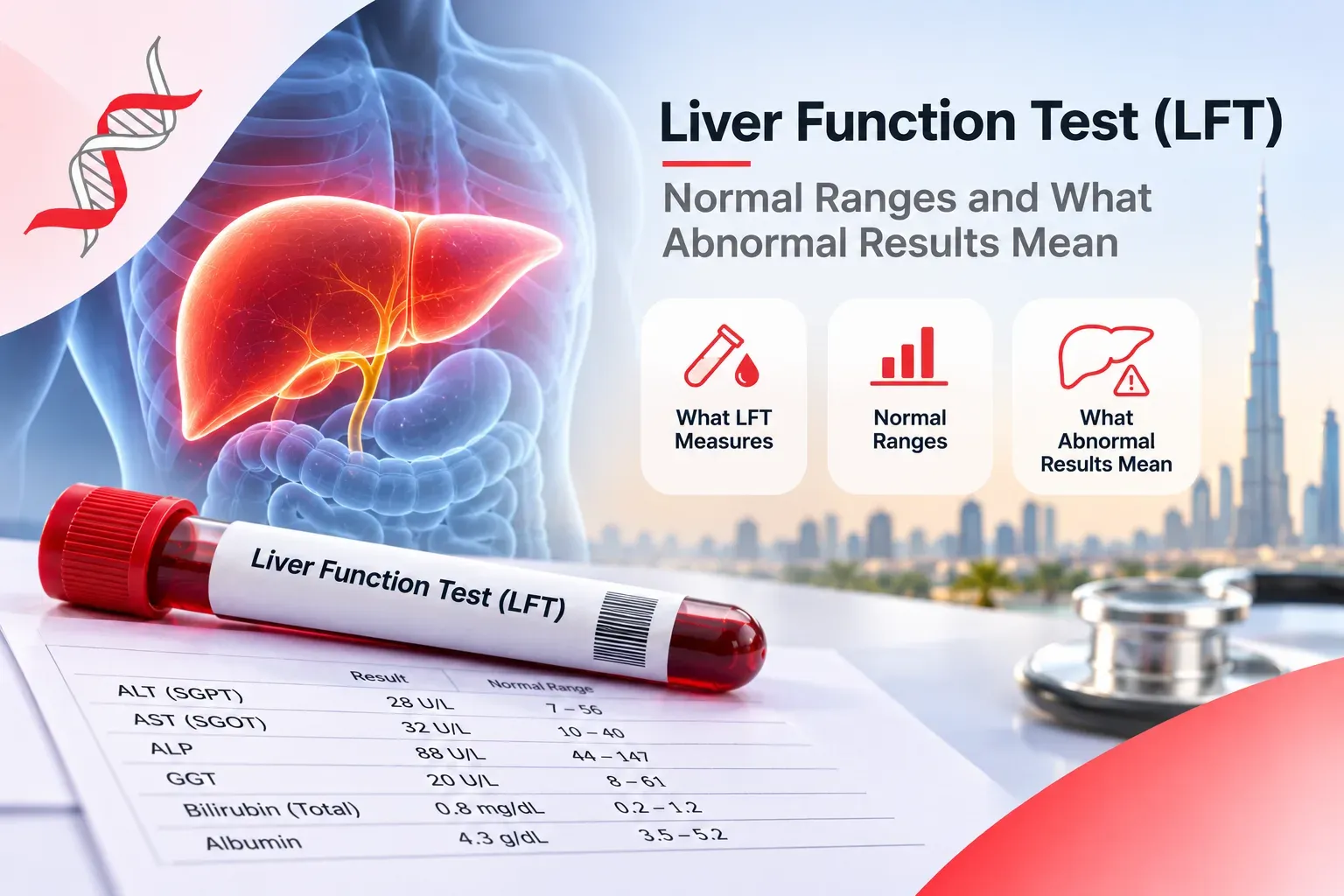
The Intel Lab Liver Profile reports ten markers from one blood sample.
The liver's ability to make protein. It changes slowly.
Protein, Total, Serum
The total amount of protein in the blood, including albumin and globulin
A general measure that is not specific to the liver
Globulin
The group of blood proteins other than albumin
A general measure that is not specific to the liver
The profile does not include prothrombin time (INR), which the guidelines list as a marker of liver function.12 It is not in our online catalog, but the lab can run it on request: contact us.
Related test
Liver Function Test (LFT)
LFT is a comprehensive panel that evaluates liver health by measuring enzymes (ALT, AST, ALP, GGT), bilirubin, albumin, and total protein. It helps…
Starting at
89
What are the normal ranges?
Reference ranges differ from one laboratory to another, so always read your result against the range printed on your own report.1 The table below shows the bands Intel Lab reports for each marker.
Marker
Normal
Other bands on the report
Alanine Aminotransferase (ALT/SGPT)
0 to 55 U/L
Mildly raised: 56 to 165 U/L. High: above 165 U/L.
Aspartate Aminotransferase (AST/SGOT)
0 to 40 U/L
Mildly raised: 41 to 120 U/L. High: above 120 U/L.
Alkaline Phosphatase (ALP)
44 to 147 U/L
Low: below 44 U/L. High: above 147 U/L.
Gamma Glutamyl Transferase (GGT)
0 to 60 U/L
Mildly raised: 61 to 180 U/L. High: above 180 U/L.
Bilirubin, Total
0.1 to 1.2 mg/dL
Mildly raised: 1.3 to 3 mg/dL. High: above 3 mg/dL.
Bilirubin, Direct
0 to 0.3 mg/dL
Mildly raised: 0.4 to 1 mg/dL. High: above 1 mg/dL.
Bilirubin, Indirect (Unconjugated)
0.1 to 1 mg/dL
Mildly raised: 1.1 to 3 mg/dL. High: above 3 mg/dL.
Albumin
3.5 to 5 g/dL
Low: below 3.5 g/dL. High: above 5 g/dL.
Protein, Total, Serum
6 to 8.3 g/dL
Low: below 6 g/dL. High: above 8.3 g/dL.
Globulin
2 to 3.5 g/dL
Low: below 2 g/dL. High: above 3.5 g/dL.
Two points help when you read these bands:
"Normal" for ALT is debated. The ACG argues that a truly healthy ALT is lower than many laboratory ranges allow, and that it differs between men and women.1 For this reason a physician may take an interest in an ALT near the top of the normal band if you have risk factors for liver disease.
"Mildly raised" does not mean "safe to ignore". The size of an abnormal result is not a reliable guide to its importance.2
What does a raised ALT or AST mean?
When ALT and AST are raised out of proportion to ALP, physicians call this a hepatocellular pattern. It points to injury of the liver cells themselves.1 The guidelines list these as common liver causes:12
Fatty liver disease, now called metabolic dysfunction-associated steatotic liver disease (MASLD) and previously called NAFLD5
Alcohol-related liver disease
Viral hepatitis, including hepatitis B and hepatitis C
Prescribed medicines, over-the-counter medicines, and herbal or dietary supplements
Less common conditions such as autoimmune hepatitis and haemochromatosis (iron overload)
When the cause is not the liver
AST and ALT can also rise for reasons outside the liver. The ACG lists skeletal muscle damage, strenuous exercise, thyroid disease and haemolysis (the breakdown of red blood cells) among them. A raised AST with a normal ALT suggests a heart or muscle source.1 To separate these causes, a physician may request a muscle enzyme such as Creatine Kinase (CPK) or a Thyroid Stimulating Hormone (TSH) test.1
Fatty liver: what an LFT cannot show
MASLD is fat in the liver in a person who has at least one cardiometabolic risk factor, such as type 2 diabetes or obesity, and who does not drink harmful amounts of alcohol.5 A liver function test cannot diagnose fatty liver, and it cannot measure scarring. European guidelines advise a stepwise assessment with blood-based scores such as FIB-4, followed by imaging such as transient elastography.5 Intel Lab does not offer liver imaging. If blood sugar is part of your risk, our guide to HbA1c and its normal range explains that test.
Related test
Alanine Aminotransferase (ALT/SGPT)
ALT is a liver enzyme that is released into the blood when liver cells are damaged. This test helps detect liver inflammation or injury from…
Starting at
15
What does a raised ALP or GGT mean?
When ALP is raised out of proportion to ALT and AST, the pattern is called cholestatic. It suggests that bile is not flowing freely.1 Causes include a blocked bile duct and conditions that affect the bile ducts, such as primary biliary cholangitis and primary sclerosing cholangitis.2
ALP does not come only from the liver
Bone is the most common source of ALP outside the liver. Levels are naturally higher in children because of bone growth, in pregnancy because the placenta produces ALP, and in older people, especially women over 50.1 When ALP is the only raised marker, the BSG says the most likely explanations are vitamin D deficiency or normal childhood growth.2 Our guide to vitamin D deficiency covers that test.
This is where GGT helps. GGT is not found in bone, so a raised GGT alongside a raised ALP points to the liver as the source.2 The Liver Profile includes both markers so that this comparison can be made from one sample.
A raised GGT on its own
GGT is most commonly raised by obesity, excess alcohol or medicines.2 It is not specific for liver disease, and the ACG advises against using it alone as a screening test when the other liver markers are normal.1
Bilirubin, albumin and protein: the function markers
Bilirubin
A raised direct bilirubin suggests liver cell disease or blocked bile flow.1 A raised bilirubin when every other liver marker is normal is different. The most common cause is Gilbert's syndrome, which affects 5 to 8% of the population.2 It is an inherited condition that does not damage the liver and usually needs no treatment. It can cause mild yellowing of the eyes or skin that comes and goes, and episodes may follow over-exercising, poor sleep, alcohol or not drinking enough fluids.4
Only a physician can decide that Gilbert's syndrome is the explanation. They will first consider other causes, including faster breakdown of red blood cells, particularly if you also have anaemia.2
Albumin
Albumin stays in the circulation for about 3 weeks, so it falls slowly. A low level usually suggests a liver problem that has been present for more than 3 weeks.1 However, low albumin is common without any liver disease. Other causes include severe infection, inflammatory conditions, kidney disease that leaks protein, poor absorption of nutrients, and protein loss from the gut.2
Total protein and globulin
These two results are not specific to the liver. A physician reads them together with albumin and the rest of your results. If either falls in a low or high band, ask your physician what it means for you.
Related test
Gamma Glutamyl Transferase (GGT)
GGT is a liver enzyme that is particularly sensitive to alcohol use and bile duct obstruction. Elevated levels can help differentiate liver from bone…
Starting at
25
How to prepare, how long results take, and which option to book
Fasting is recommended for the Liver Profile, but it is not mandatory. An overnight fast of 8 to 12 hours, with plain water allowed, gives the cleanest reading, because ALP can rise after a fatty meal in some people.1
Medicines and supplements: tell your doctor about everything you take, including over-the-counter and herbal products. Do not stop any medicine unless your doctor tells you to.3
Exercise: strenuous exercise can raise AST and ALT.1 If you trained hard shortly before the test, mention it to the physician who reads your result.
Collection: the sample is blood. Home collection is available anywhere in Dubai, 7 days a week, from 6am to 10pm, and is included in the package price.
Results: the Liver Profile has a turnaround of 24 hours, and you receive a physician-reviewed digital report.
Yes (it includes fasting glucose and cholesterol tests)
24 hours
Check the contents before you choose. Basic Wellness includes two liver enzymes, not a full liver panel: it has no ALP, GGT, bilirubin or albumin.
Single tests are also available, for example Alanine Aminotransferase (ALT/SGPT) at AED 15 and Gamma Glutamyl Transferase (GGT) at AED 25. These are useful when your doctor has asked for one marker to be rechecked. A single test booked alone carries a collection fee, which is shown before payment, so for the full panel the package is usually the simpler choice.
Related package
Basic Health Checkup
Blood count, liver, kidney, cholesterol, blood sugar and urine tests: the essentials in one visit.
Starting at
199
What to do with your result, and who should test
If every marker is normal
This is reassuring, but it is not proof of a healthy liver.2 If you have risk factors or symptoms, discuss them with a physician even when your results are normal.
If a marker is flagged
Do not ignore it, and do not assume the worst. In a UK primary care study described in the BSG guideline, 84% of abnormal liver blood tests were still abnormal when repeated one month later.2 Waiting for the number to settle is therefore not a plan. Both guidelines expect a physician to look for the cause, starting with your medicines and supplements, alcohol intake and metabolic risk factors, and often a repeat or clarifying test.12
For adults, the BSG lists a standard set of next investigations: an abdominal ultrasound, hepatitis B surface antigen, hepatitis C antibody, autoantibodies, immunoglobulins, and ferritin with transferrin saturation, with a full blood count if one has not been done recently.2 If your physician requests them, Intel Lab offers Hepatitis B Surface Antigen (HBsAg) at AED 55, Hepatitis C Antibody (Anti-HCV) at AED 75, Ferritin at AED 55 and Complete Blood Count (CBC) at AED 35. Our guide to STD testing in Dubai explains hepatitis B and C testing and confidentiality. Immunoglobulins and prothrombin time (INR) are not in our online catalog, but the lab can run them on request: contact us. Intel Lab does not offer ultrasound, so your physician will arrange that elsewhere.
When not to wait for a routine test
Symptoms of liver disease include yellowing of the skin or eyes, dark urine or pale stools, swelling or pain in the abdomen, swelling in the ankles and legs, frequent itching, nausea, loss of appetite and unusual tiredness.3 Unexplained jaundice needs immediate medical assessment.24 If you have these symptoms, see a doctor promptly instead of booking a home test.
Who should consider testing
Liver function tests are often part of a routine checkup. They are also used for people with a family history of liver disease, obesity, diabetes, heavy alcohol use, hepatitis or exposure to hepatitis, and for people who take medicines that can affect the liver.3 European guidelines also advise looking for liver disease in people with type 2 diabetes, or with obesity and other metabolic risk factors.5 How often to repeat the test depends on your risk factors and your earlier results, and is a decision for your physician.
Related test
Hepatitis B Surface Antigen (HBsAg)
HBsAg is the first detectable marker of hepatitis B infection. A positive result indicates active hepatitis B, either acute or chronic. This test is…
Starting at
55
Book a liver function test in Dubai
The Liver Profile measures all 10 markers in this guide for AED 89, with results in 24 hours and home collection in Dubai included. If you are not sure which test fits your situation, ask a clinician first.
This article is for general education and is not a substitute for medical advice. Yellowing of the skin or eyes needs prompt medical assessment and should not wait for a routine blood test. Intel Lab Diagnostics is licensed by the Dubai Health Authority (licence 0046381) and accredited by EIAC to ISO 15189:2022. Prices and turnaround times were verified on 12 November 2026.
Helpful? Let us know
Was this helpful?
Laboratory tests
Related tests you can book
Health package
Liver Profile
Ten liver markers from one blood sample: enzymes (ALT, AST, ALP, GGT), bilirubin and liver proteins.
From 89
Health package
Basic Health Checkup
Blood count, liver, kidney, cholesterol, blood sugar and urine tests: the essentials in one visit.
From 199
Blood test
Liver Function Test (LFT)
LFT is a comprehensive panel that evaluates liver health by measuring enzymes (ALT, AST, ALP, GGT), bilirubin, albumin, and total protein. It helps…
From 89
Blood test
Alanine Aminotransferase (ALT/SGPT)
ALT is a liver enzyme that is released into the blood when liver cells are damaged. This test helps detect liver inflammation or injury from…
From 15
Blood test
Gamma Glutamyl Transferase (GGT)
GGT is a liver enzyme that is particularly sensitive to alcohol use and bile duct obstruction. Elevated levels can help differentiate liver from bone…
From 25
Blood test
Hepatitis B Surface Antigen (HBsAg)
HBsAg is the first detectable marker of hepatitis B infection. A positive result indicates active hepatitis B, either acute or chronic. This test is…
From 55
FAQ
Frequently Asked Questions
Common questions on this topic, answered by our lab team. Can't find yours?
Each marker has its own range, and ranges differ between laboratories, so use the range printed on your own report. The normal bands Intel Lab reports are: ALT 0 to 55 U/L, AST 0 to 40 U/L, ALP 44 to 147 U/L, GGT 0 to 60 U/L, total bilirubin 0.1 to 1.2 mg/dL, direct bilirubin 0 to 0.3 mg/dL, indirect bilirubin 0.1 to 1 mg/dL, albumin 3.5 to 5 g/dL, total protein 6 to 8.3 g/dL and globulin 2 to 3.5 g/dL.
ALT and AST rise when liver cells are injured. Common liver causes are fatty liver disease, alcohol-related liver disease, viral hepatitis B and C, and medicines or supplements. Causes outside the liver include muscle injury, strenuous exercise and thyroid disease, and AST in particular also comes from heart and skeletal muscle. The result shows that something needs explaining. It does not show the cause, which a licensed physician works out from your history and further tests.
Yes. British guidelines state that normal liver blood tests do not rule out advanced fibrosis or cirrhosis, and that ALT and AST can both be normal in cirrhosis. A liver function test also cannot diagnose fatty liver or measure liver scarring. If you have risk factors or symptoms, speak to a physician even when your results are normal.
Fasting is recommended for the Liver Profile but it is not mandatory. An overnight fast of 8 to 12 hours, with plain water allowed, gives the cleanest reading, because ALP can rise after a fatty meal in some people. Tell your doctor about all the medicines and supplements you take, and do not stop any medicine unless your doctor tells you to.
At Intel Lab the Liver Profile costs AED 89 and measures 10 liver markers, with home collection in Dubai included in the package price. The Basic Health Checkup costs AED 199 and includes the same 10 liver markers together with kidney, cholesterol, fasting glucose, blood count and urine tests.
The Liver Profile has a turnaround of 24 hours. Results are delivered as a physician-reviewed digital report.
It depends on the pattern. When bilirubin is the only raised marker, the most common cause is Gilbert's syndrome, an inherited condition that affects 5 to 8% of the population, does not damage the liver and usually needs no treatment. A raised direct bilirubin points towards liver cell disease or blocked bile flow. Yellowing of the skin or eyes that has not been explained needs prompt medical assessment.
A raised ALP out of proportion to ALT and AST suggests a problem with bile flow, but ALP also comes from bone. It is naturally higher in children, in pregnancy and in older people, and an isolated raised ALP is most likely due to vitamin D deficiency or normal childhood growth. GGT is not found in bone, so a raised GGT alongside a raised ALP points to the liver. GGT on its own is most commonly raised by obesity, excess alcohol or medicines, and it is not specific for liver disease.
References & Sources
This article cites peer-reviewed research and guidance from recognised medical authorities.
Specialisation: Clinical PathologyDHA Reg. No. 65077850-00725+ years experience
Dr Nirupama Sabhapathy is a DHA-licensed Specialist in Clinical Pathology and Lab Director at Intel Lab, Dubai. She oversees laboratory operations and quality assurance across every testing panel, and each abnormal result passes a specialist review before it reaches you.
Dr Nirupama Sabhapathy is a DHA-licensed Specialist in Clinical Pathology and Lab Director at Intel Lab, Dubai. She trained at the Manipal Academy of Higher Education and holds the DNB in Pathology from the National Board of Examinations, New Delhi.