Fasting Before a Blood Test: Water, Coffee and Medication Rules
What fasting for a blood test really means: water, black coffee, medication, how many hours, and which tests need no fasting at all. Fasting panels from AED 89.
Medically Reviewed Evidence Based 11 min read·Updated 3 October 2026
DHA
DHA Compliant
Dubai Health Authority
EIAC
EIAC Accredited
ISO 15189:2022
11 min
Reading time
Medically Reviewed
Medically reviewed
Oct 2026
Last updated
7 sources
Evidence cited
On this page
Key Takeaways
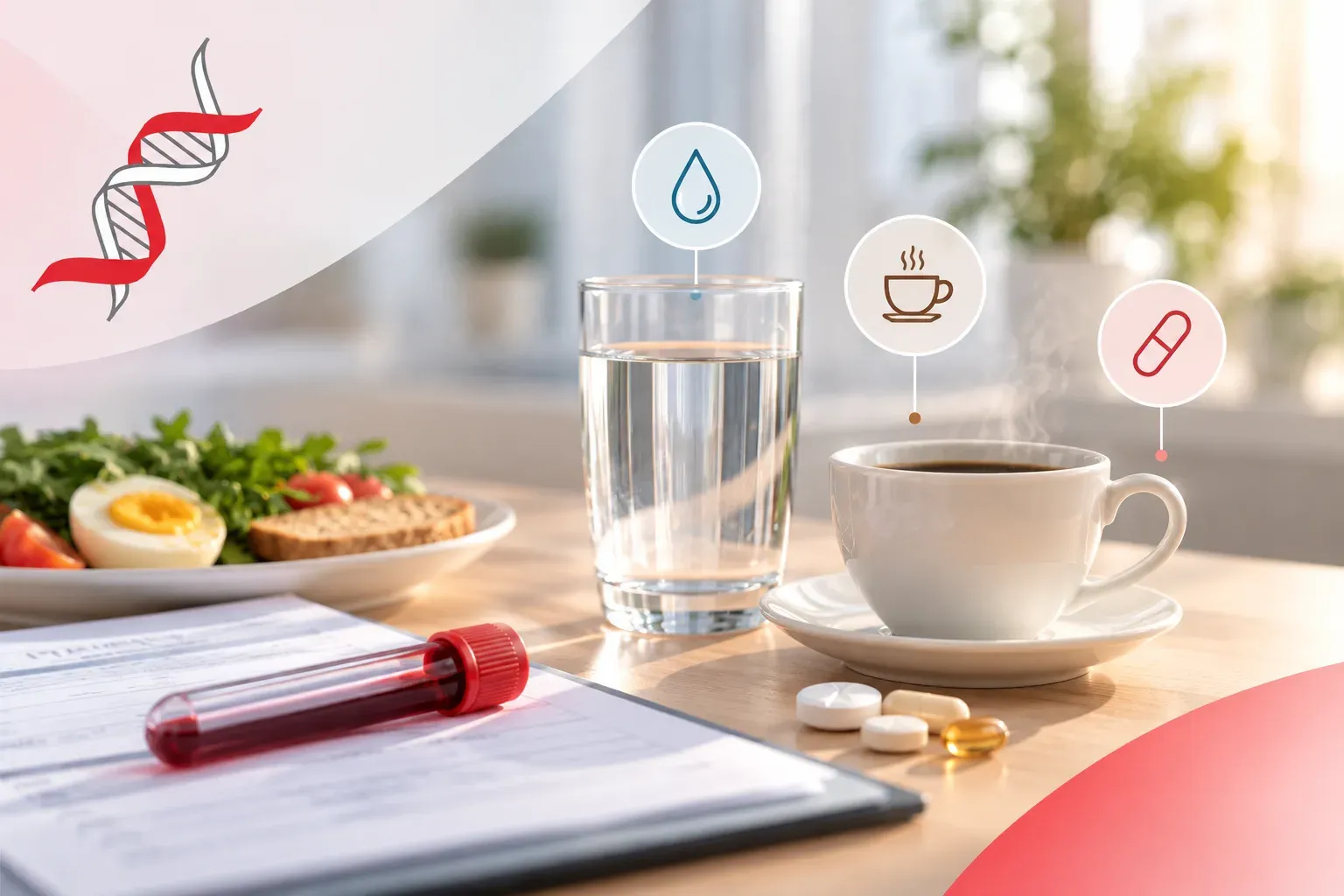
Fasting for a blood test means no food and no drinks except plain, still water. Aim for 10 to 12 hours: at least 8 hours for fasting glucose, and no more than 16 hours in total.
Black coffee, tea, juice, chewing gum and cigarettes all break a fast. European laboratory guidance asks you to avoid caffeine and smoking on the morning of the test and alcohol for 24 hours before it.
Keep taking prescribed medication with water unless your doctor tells you otherwise, and mention supplements: high-dose biotin can make thyroid, hormone and vitamin D results falsely high or falsely low.
Many tests need no fasting, including HbA1c (AED 45), the Complete Blood Count, thyroid function and vitamin D. Fasting visits include the Lipid / Cholesterol Profile (AED 89) and the Basic Health Checkup (AED 199, results in 24 hours).
If you have diabetes, fasting raises the risk of low blood sugar, so agree a plan with your doctor before you fast, and treat a low reading straight away: the test can always be rebooked.
"Fast before your blood test" sounds like a simple instruction until the night before, when the real questions arrive: can you drink water, does black coffee count, and what about the tablets you take every morning? If the answers you find online disagree, that is not your fault. Laboratories themselves have not always defined fasting in the same way.1
This guide explains what fasting means for a blood test, which tests need it and which do not, what you can drink, how to handle medication and supplements, and what to do if you make a mistake.
Important: This article is for general education and does not replace medical advice. Laboratory results should always be interpreted by a licensed physician in the context of your individual history and examination.
Related package
Basic Health Checkup
Our high value proposition with a comprehensive list of essential tests
Starting at
199
Start here: fasting means no food and no drinks except plain water
For a blood test, fasting is not only about food. It means nothing to eat and nothing to drink except plain, still water. Water is allowed, and there is no benefit in going thirsty.
The clearest international definition comes from laboratory medicine. The European Federation of Clinical Chemistry and Laboratory Medicine (EFLM) recommends a 12-hour fast during which water is permitted, no alcohol for 24 hours before the sample, and no smoking or caffeine-containing drinks, such as tea or coffee, on the morning of the test.1 Public health guidance gives the same practical message: still, plain water only, with no tea, coffee, soft drinks or milk, and no chewing gum or sweets.4
Why this matters. Eating changes your blood for hours, not minutes. The EFLM working group describes clinically significant changes for up to four hours after a meal in triglycerides, the liver enzymes ALT and AST, calcium, sodium, potassium, C-reactive protein, uric acid and bilirubin, and a fall in the lymphocyte count within an hour.1 A fasting test compares your result with reference values established in fasting people. If your sample was not fasting, that comparison no longer holds.
Not every test needs it. Many common tests can be taken at any time of day, after breakfast. The next section sets out which is which.
Which tests need fasting, and which do not
The table follows the preparation rule for each test on our menu. One rule keeps packages simple: if any test in a package needs fasting, fast for the whole visit.
Test
Fasting needed?
Note
Glucose, Fasting
Yes
At least 8 hours with no calorie intake, by definition3
The Liver Profile surprises people. It needs fasting because it includes alkaline phosphatase, which a meal can raise slightly for a few hours in some people.1
Cholesterol tests: the guidance has changed
For decades, a cholesterol test meant an overnight fast. In 2016, a joint consensus statement from the European Atherosclerosis Society and the EFLM recommended that non-fasting samples be used routinely for most lipid profiles, because a normal meal changes most lipid results only slightly.2 Triglycerides move the most after food, and the statement suggests repeating the profile fasting when a non-fasting triglyceride result is above 5 mmol/L (440 mg/dL).2
Two practical points follow. First, our lipid tests are booked as fasting tests, so follow the instruction on your booking unless your doctor has asked specifically for a non-fasting sample, and tell us if so. Second, if you are comparing with earlier results, prepare the same way each time. A fasting result and a non-fasting result are not a fair comparison.
Related package
Diabetics Profile
Medical laboratory screening of your Diabetes status within 24 hours
Starting at
89
Related package
Lipid / Cholesterol Profile
A comprehensive analysis of your cholesterol levels with key insights
Starting at
89
Coffee, tea, juice, gum and cigarettes
Black coffee
This is the most common question, and the answer is no. Black coffee has almost no calories, which is why many people assume it is allowed, but laboratory guidance asks you to avoid caffeine-containing drinks on the morning of a fasting test.1
There is a measurable reason. The EFLM working group cites data showing fasting blood glucose rising by almost 12% within an hour of one café latte, with a larger effect in women and in people who are overweight.1 To be precise about the evidence: a latte contains milk, so that figure does not isolate coffee itself, and plain black coffee has been studied less. The guidance is consistent all the same, and waiting costs you only a few hours. Have your coffee straight after the sample is taken.
Tea, juice and other drinks
Tea of any kind, juice, soft drinks (including diet versions), flavoured or sparkling water, and milk all count as more than water.4 That includes karak, laban and sports drinks. If it is not plain, still water, it waits until after the sample.
Chewing gum, mints and sweets
Avoid chewing gum, mints and sweets during the fasting period.4 The guidance makes no exception for sugar-free versions.
Smoking and nicotine
Do not smoke on the morning of the test.1 NHS patient guidance applies the same rule to vaping and to nicotine gum.5
Alcohol
Avoid alcohol for 24 hours before a fasting sample.1 A drink the evening before can still affect results the next morning, even when you have stopped eating at the right time.
Medication: keep taking it unless your doctor tells you otherwise
The default is simple. Take your regular prescribed medicines as usual, with plain water, unless the doctor who prescribed them or requested the test tells you otherwise.4 A few sips of water to swallow tablets are within the fasting rules.
Three situations need a conversation with your doctor before the day of the test, not on the morning itself:
Medicines for diabetes, including insulin. Taking them while fasting can cause low blood sugar. The section on diabetes below explains what to ask.
Medicines that must be taken with food. Ask how to handle that morning, rather than taking them on an empty stomach or leaving them out.
Medicines your doctor is monitoring with the test. For some tests the timing of the last dose matters, and your doctor will tell you if it does.
Never stop or skip a medicine on your own to prepare for a blood test. A result can be interpreted with your medication in mind. A missed dose cannot be undone.
Tell the nurse what you take, including over-the-counter medicines and supplements, so it can be noted for the physician who reviews your report.4
Supplements, and why biotin matters
Biotin (vitamin B7) is sold in supplements for hair, skin and nails and is included in some multivitamins. At high intakes it can interfere with a widely used laboratory method that relies on biotin, which is used to measure hormones such as thyroid hormones as well as vitamin D. The result can be falsely normal or falsely abnormal.6 In one report, a single 10 mg dose of biotin interfered with thyroid function tests taken within 24 hours.6
This is not a reason to stop a supplement on your own. It is a reason to mention it. Tell your doctor and the nurse if you take biotin, and ask your doctor whether it should be paused before thyroid, hormone or vitamin D tests.
Related test
Glucose Tolerance Test (GTT, 75 Grams)
The 75g GTT measures your body's ability to handle a glucose load. Blood sugar is measured fasting and at 1 and 2 hours after drinking 75 grams of…
Starting at
50
How long to fast, and when to book
For most fasting tests, aim for 10 to 12 hours with nothing but water.
The minimum. For fasting glucose, the American Diabetes Association defines fasting as no calorie intake for at least 8 hours.3 A shorter fast does not produce a fasting sample.
The standard. The EFLM recommends 12 hours.1 Stopping after your evening meal gives most people 10 to 12 hours by the next morning.4
The maximum. Longer is not better. Public health guidance advises that a fasting blood test should be taken after no more than 16 hours of fasting.4
Book a morning slot. Fasting tests are usually taken in the morning,4 and the EFLM prefers 7am to 9am, partly because many reference values were established on morning samples.1 Our home collection starts at 6am, seven days a week, anywhere in Dubai, so an early slot means your sample is taken before you would normally have breakfast. For example, if your collection is booked for 7:30am, finish eating by about 8pm the evening before and drink water as usual.
Eat a normal dinner. NHS patient guidance confirms that you can eat your evening meal the night before a fasting test.5 An ordinary meal is better than an unusually large or fatty one, because fat from a heavy meal can still affect a sample 9 to 10 hours later.1
If you have diabetes, are pregnant, or find fasting difficult
Diabetes. Fasting while taking insulin or some diabetes medicines raises the risk of low blood sugar (hypoglycaemia). Speak to your doctor before you fast, and ask for written instructions covering how often to check your glucose, any changes to your medicines or insulin, and how to prevent and treat a low reading.4 Keep a sugary drink nearby, and avoid driving while you are fasting.4 Home collection helps here, because you do not need to travel to be tested.
If your blood sugar drops, treat it. Your safety comes before any test. Tell the nurse, and the fasting tests can be taken on another day.
It is also worth asking your doctor whether you need a fasting test at all. HbA1c needs no preparation,3 and the European consensus specifically supports non-fasting lipid profiles in people with diabetes, to avoid hypoglycaemia.2 Our guide to HbA1c and its normal range explains what the test measures.
Pregnancy and breastfeeding. Speak to your doctor about how to fast safely.4 If you have been asked to have a glucose tolerance test in pregnancy, expect an overnight fast of about 10 hours.4 Our Glucose Tolerance Test (GTT, 75 Grams) (AED 50) starts with a fasting sample, followed by a measured glucose drink and further timed samples, so plan for a morning rather than a few minutes.
Other difficulties. If fasting makes you feel unwell, or you have fainted at blood tests before, tell us when you book and choose the earliest slot so that your fast is as short as it can be.
Related package
Thyroid Function
Our most essential investigation of our thyroid function with results in 24 hours
Starting at
199
Related test
HbA1c
HbA1c measures your average blood sugar levels over the past 2–3 months by analysing the percentage of glycated haemoglobin. It is a key test for…
Starting at
45
If you ate or drank something by mistake
It happens: a coffee out of habit, or a biscuit before you remembered. The right response is simple. Tell the nurse exactly what you had and when.
A non-fasting sample processed as a fasting one can produce a result that looks abnormal for reasons that have nothing to do with your health, and that can lead to worry, repeat tests or a wrong conclusion. The EFLM working group's position is that, for routine testing, a poorly prepared sample is worse than no sample at all.1
Usually the best course is to move the fasting tests to another morning. If your visit also includes tests that need no fasting, ask whether those can still go ahead. Water, and tablets taken with water, do not count as mistakes.
Your results are back: reading them in the right context
Every report is reviewed by a physician, and that review is only as good as the information behind it. Tell us if your sample was not fully fasting and when you last ate, because it changes how some results are read.
Glucose. A raised glucose from a sample that was not truly fasting cannot be judged against fasting thresholds. Even a raised fasting result does not diagnose diabetes by itself: without clear symptoms, the American Diabetes Association requires the result to be confirmed by repeat testing.3
Triglycerides. These rise the most after food. A high non-fasting triglyceride result, particularly above 5 mmol/L, is a reason to repeat the test fasting rather than to draw conclusions.2
Trends over time. If you are tracking results, keep the preparation and the time of day the same each time. Morning fasting samples compared with morning fasting samples give the clearest picture.1
Take your results to a doctor. A single number, normal or abnormal, is one piece of information. Your doctor reads it alongside your history, your medicines and, where it matters, how you prepared.
How often you need fasting tests depends on which test your doctor needs, not on a fixed schedule. If you are unsure whether your test needs fasting, ask before you book. It is a quick question, and it can save a wasted visit.
Book a fasting blood test
The Basic Health Checkup covers 63 biomarkers, including fasting glucose, a lipid profile, liver and kidney markers and a complete blood count, for AED 199 with results in 24 hours. Home collection starts at 6am anywhere in Dubai, so you can fast overnight and have your sample taken before breakfast. Book the Basic Health Checkup, or ask a clinician first if you are not sure which test you need or how to prepare.
This article is for general education and is not a substitute for medical advice. Do not stop, delay or change any medication or supplement to prepare for a blood test without speaking to your doctor, and if you have diabetes, agree a fasting plan with your doctor before you fast. Intel Lab Diagnostics is licensed by the Dubai Health Authority (licence 0046381) and accredited by EIAC to ISO 15189:2022. Prices and turnaround times were verified on 3 October 2026.
Helpful? Let us know
Was this helpful?
Laboratory tests
Related tests you can book
Health package
Basic Health Checkup
Our high value proposition with a comprehensive list of essential tests
From 199
Health package
Lipid / Cholesterol Profile
A comprehensive analysis of your cholesterol levels with key insights
From 89
Health package
Diabetics Profile
Medical laboratory screening of your Diabetes status within 24 hours
From 89
Blood test
HbA1c
HbA1c measures your average blood sugar levels over the past 2–3 months by analysing the percentage of glycated haemoglobin. It is a key test for…
From 45
Blood test
Glucose Tolerance Test (GTT, 75 Grams)
The 75g GTT measures your body's ability to handle a glucose load. Blood sugar is measured fasting and at 1 and 2 hours after drinking 75 grams of…
From 50
Health package
Thyroid Function
Our most essential investigation of our thyroid function with results in 24 hours
From 199
FAQ
Frequently Asked Questions
Everything you need to know about our tests and bookings. Can't find what you're looking for?
Yes. Plain, still water is allowed during the fasting period and you can drink your usual amount. Sparkling or flavoured water, tea, coffee, juice, soft drinks and milk are not allowed until after the sample is taken.
No. Even without milk or sugar, coffee contains caffeine, and European laboratory guidance asks you to avoid caffeine-containing drinks on the morning of a fasting test. Have your coffee straight after the sample is taken.
In most cases, yes. Take your regular prescribed medicines with water as usual unless your doctor tells you otherwise. If you take insulin or other diabetes medicines, or a medicine that must be taken with food, speak to your doctor before the day of the test. Never stop a medicine on your own to prepare for a blood test.
Aim for 10 to 12 hours with nothing but water, which for most people means finishing dinner in the evening and having the sample taken early the next morning. Fasting glucose needs at least 8 hours, and fasting for longer than 16 hours is not recommended.
European guidance since 2016 supports non-fasting cholesterol tests for most people, because a normal meal changes most results only slightly. Our lipid tests are booked as fasting tests, so follow the instruction on your booking unless your doctor has asked specifically for a non-fasting sample, and prepare the same way each time if you are comparing results.
HbA1c, the Complete Blood Count (CBC), thyroid tests (TSH, FT4 and FT3), vitamin D, vitamin B12, folate, kidney markers such as creatinine and eGFR, and reproductive hormones such as FSH and LH can all be taken without fasting. If a package mixes fasting and non-fasting tests, fast for the whole visit.
Single-focus fasting panels such as the Lipid / Cholesterol Profile, the Diabetics Profile and the Iron Profile are AED 89 each. The Basic Health Checkup, which covers 63 biomarkers including fasting glucose and a lipid profile, is AED 199. Home collection anywhere in Dubai is included in the price.
Results for the Basic Health Checkup, the Lipid / Cholesterol Profile and the Diabetics Profile are ready within 24 hours, delivered as a physician-reviewed digital report.
References & Sources
This article cites peer-reviewed research and guidance from recognised medical authorities.
Specialisation: Clinical PathologyDHA Reg. No. 65077850-00725+ years experience
Dr Nirupama Sabhapathy is a DHA-licensed Specialist in Clinical Pathology and Lab Director at Intel Lab, Dubai. She oversees laboratory operations and quality assurance across every testing panel, and each abnormal result passes a specialist review before it reaches you.
Dr Nirupama Sabhapathy is a DHA-licensed Specialist in Clinical Pathology and Lab Director at Intel Lab, Dubai. She trained at the Manipal Academy of Higher Education and holds the DNB in Pathology from the National Board of Examinations, New Delhi.