Medically Reviewed Evidence Based 13 min read·Updated 7 October 2026
DHA
DHA Compliant
Dubai Health Authority
EIAC
EIAC Accredited
ISO 15189:2022
13 min
Reading time
Medically Reviewed
Medically reviewed
Oct 2026
Last updated
7 sources
Evidence cited
On this page
Key Takeaways
Ferritin measures your stored iron and is the single most useful blood marker for iron deficiency. Serum iron reflects recent intake and should not be used on its own to diagnose it.
Iron stores run down before haemoglobin falls, so you can be iron-deficient with a normal blood count. The WHO defines anaemia in adults as haemoglobin below 130 g/L in men and below 120 g/L in non-pregnant women.
Ferritin rises with inflammation, so a normal result can hide a deficiency. The WHO accepts a ferritin below 70 µg/L as a possible sign of iron deficiency in adults with infection or inflammation, and a CRP test (AED 60) helps show whether inflammation is present.
Our Iron Profile (AED 89) and Anemia Profile (AED 129) do not include ferritin. Ferritin is AED 55 and needs no fasting, so the Anemia Profile plus Ferritin comes to AED 184, and the Advanced Health Checkup (AED 299) includes ferritin, iron, TIBC and a full blood count.
A confirmed iron deficiency needs a cause. About a third of men and post-menopausal women with iron deficiency anaemia have an underlying condition, most often in the gut, so a doctor should guide what happens next.
Many people who feel persistently tired or short of breath ask for "an iron test", get a normal result and are told their iron is fine. The difficulty is that serum iron is one of the least reliable ways to find iron deficiency, and the test that does answer the question, ferritin, is often not on the request at all.
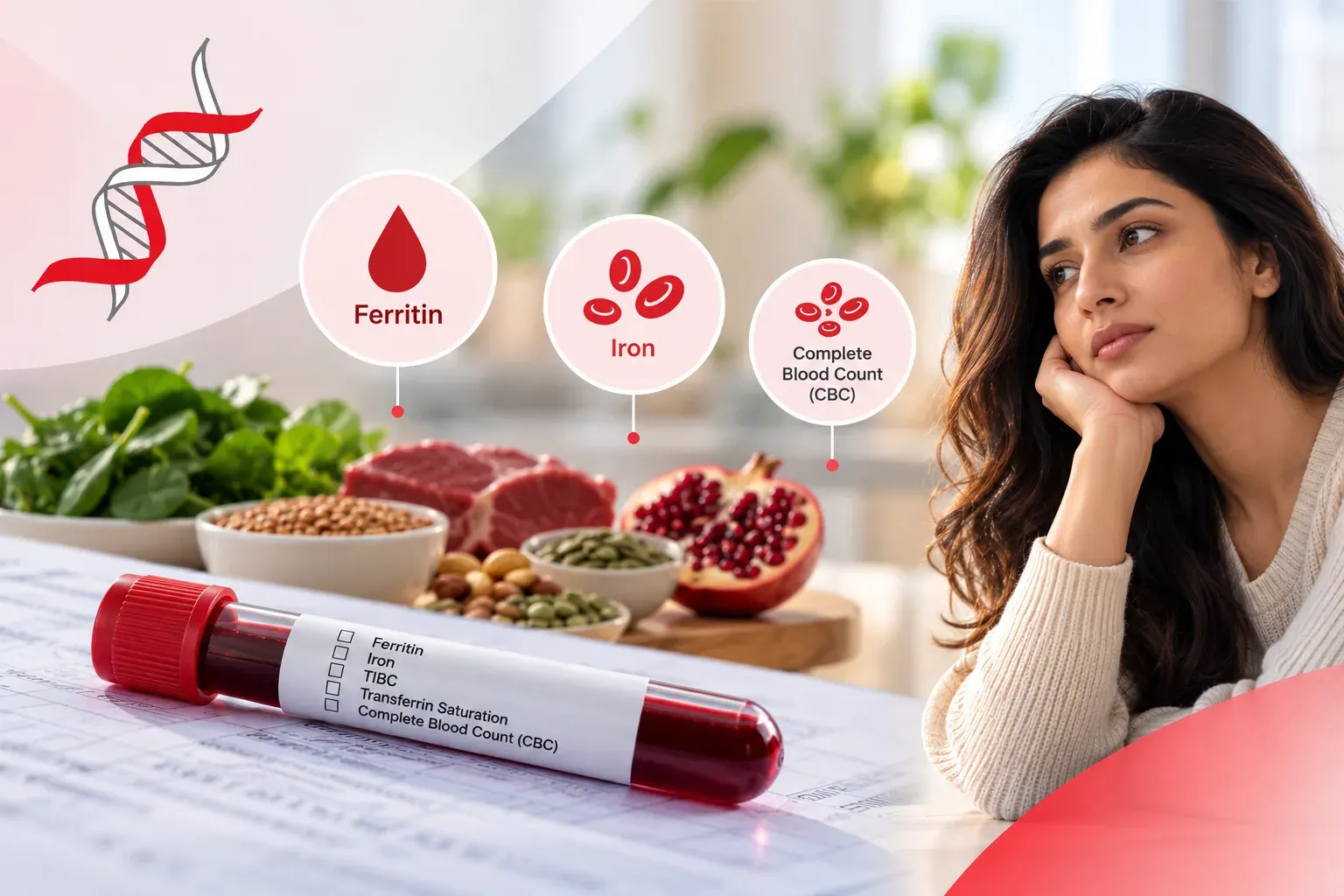
This guide explains what ferritin, serum iron, TIBC and a full blood count each measure, how to read them together, which of our panels actually include ferritin, and what a confirmed deficiency should lead to next.
Important: This article is for general education and does not replace medical advice. Laboratory results should always be interpreted by a licensed physician in the context of your individual history and examination.
Related package
Anemia Profile
A complete blood count, serum iron and vitamin B12 from one blood sample, to check for anaemia and two of its common causes.
Starting at
129
Start here: a normal iron result does not rule out iron deficiency
"Iron" on a lab report and "iron stores" in your body are two different things, and most of the confusion comes from treating them as one.
Ferritin is the protein your body uses to store iron. In the absence of inflammation, the amount in your blood tracks the size of your iron stores: low in people who are iron-deficient, high in people who are iron-loaded.3 The British Society of Gastroenterology (BSG) describes serum ferritin as the single most useful marker of iron deficiency anaemia.1
Serum iron is the iron circulating in your blood at the moment the sample is drawn. It reflects recent intake, and national guidance is clear that it should not be used to diagnose iron deficiency.2
If the question is "am I iron-deficient?", make sure ferritin is on the request. A normal serum iron on its own answers a different, much narrower question.
Iron deficiency and anaemia are not the same thing
Anaemia means your haemoglobin, the oxygen-carrying protein in red blood cells, is below the normal range. Guidelines recommend using the lower limit of the laboratory performing the test.1 The World Health Organization (WHO) defines anaemia in adults aged 15 to 65 as a haemoglobin below 130 g/L in men and below 120 g/L in non-pregnant women.4 Pregnancy and childhood have different thresholds, and your doctor will use the right ones for you.
Iron deficiency means your body does not have enough iron to meet its needs. It develops in stages. Your stores run down first, while haemoglobin is still normal. Only when the stores are exhausted does haemoglobin start to fall.1 The first stage, called non-anaemic iron deficiency, is common: in one study of young women with heavy periods, over half had reduced iron stores but only 25% were anaemic.1
Two things follow from this:
A normal blood count does not rule out iron deficiency. Even the red cell measurements that usually shrink in iron deficiency, the mean cell volume (MCV) and mean cell haemoglobin (MCH), can be normal in the early stages.2 Ferritin is what confirms it.
Not every anaemia is caused by low iron. Low vitamin B12, low folate, chronic inflammation and inherited conditions such as thalassaemia trait can all lower haemoglobin. A low haemoglobin on its own does not tell you which.
Related package
Advanced Health Checkup
A broad whole-body screen covering blood, urine and stool with kidney, liver, lipid, iron, diabetes and vitamin markers.
Starting at
299
What each test measures
An iron workup is a set of tests read together.
Test
What it measures
What it can tell you
Main limitation
Ferritin
Stored iron
Low ferritin confirms depleted stores
Rises with inflammation, infection, liver disease and cancer2
Iron (serum iron)
Iron in the blood at the time of the draw
Supporting information alongside other results
Reflects recent intake; not diagnostic on its own2
Total Iron Binding Capacity (TIBC) and Transferrin
Transferrin is the protein that carries iron; TIBC is how much iron it could carry
How much of the carrier protein is loaded with iron
Below 20% points to low iron supply, in both true and inflammation-related deficiency2
Calculated from iron and TIBC; included on our Iron Profile report. Read with ferritin, not alone
Complete Blood Count (CBC)
21 measurements, including haemoglobin, red cell count, red cell size (MCV), red cell haemoglobin content (MCH and MCHC) and variation in red cell size (RDW), plus white cells and platelets
Whether you are anaemic, and the pattern of the anaemia
Can be normal in early deficiency; small red cells also occur in thalassaemia trait1
Reading ferritin: low, borderline and falsely normal
Low ferritin
According to the BSG guideline, a ferritin below 15 µg/L indicates absent iron stores and is highly specific for iron deficiency, while a level below 30 µg/L generally indicates low stores. Most laboratories set their lower limit somewhere between 15 and 30 µg/L.1 Australian national guidance uses below 30 µg/L to diagnose iron deficiency in adults.2
Reports often print ferritin in ng/mL, which is the same as µg/L. Because laboratory lower limits vary, a result between a laboratory's lower limit and 30 µg/L may not be flagged as low, yet it is below the level that guidelines treat as generally indicating low stores.1 Your physician reads the number against your blood count and symptoms, not only against the flag on the report.
When inflammation hides a deficiency
Ferritin is also an acute phase protein, which means it rises with inflammation, infection, liver disease and some cancers. In those situations a person can be genuinely iron-deficient and still have a ferritin that looks normal.2
Guidelines handle this by raising the cut-off when inflammation is present, and they do not all agree on the exact figure:
The WHO says a ferritin below 70 µg/L may be used to indicate iron deficiency in adults with infection or inflammation.3
Australian guidance notes ferritin can be as high as 100 µg/L in adults with iron deficiency and inflammation.2
The BSG cites 45 µg/L as a suggested best balance between missing cases and over-calling them, and notes that a ferritin above 150 µg/L is unlikely in true iron deficiency even with inflammation.1
The honest summary is that there is no single cut-off that works for everyone. This is why a CRP test (AED 60) alongside ferritin is useful: it shows whether inflammation is part of the picture, and transferrin saturation can help when a falsely normal ferritin is suspected.1 Long-term conditions such as chronic kidney disease, heart failure and rheumatoid arthritis commonly cause this pattern.2
The table below shows how results tend to combine. It is a guide to the patterns a physician looks for, not a way to diagnose yourself.2
Pattern
Haemoglobin
MCV
Ferritin
Transferrin saturation
Iron deficiency without anaemia
Normal
Normal or low
Low
Low or normal
Iron deficiency anaemia
Low
Low
Low
Low
Inflammation-related (functional) iron deficiency
Low
Normal or mildly low
Normal or high
Low or normal
Thalassaemia trait
Low or normal
Low
Normal or high
Normal or high
High ferritin
A high ferritin is not automatically iron overload. The WHO suggests that a ferritin above 150 µg/L in menstruating women, or above 200 µg/L in men and non-menstruating women who are otherwise healthy, may indicate a risk of iron overload. It is equally clear that ferritin should not be used alone for that judgement, because liver disease, obesity, inflammation and cancer also raise it, and a raised result needs clinical and laboratory evaluation to find the cause.3
Related test
C-Reactive Protein (CRP)
CRP is a protein produced by the liver in response to inflammation. Elevated levels indicate an active inflammatory process, which could be caused by…
Starting at
60
Which test to book: what our panels actually include
Here we have to be direct about our own menu. Our two iron-named packages do not include ferritin. The Iron Profile measures iron, TIBC and transferrin saturation, and the Anemia Profile measures a full blood count, iron and vitamin B12. Both are useful, but neither measures your iron stores.
72 markers, including CBC, ferritin, iron, TIBC, vitamin B12 and vitamin D, plus liver, kidney, lipid and glucose tests
Yes
AED 299
Yes
24 hours
How to choose:
If you only want to know your iron stores, for example to recheck a previous low result, Ferritin on its own is the most direct test and needs no fasting. Booked on its own, without a package, it carries a collection fee, which is shown before you pay.
If you want to know whether you are anaemic and why, you need a blood count and ferritin together. The Anemia Profile plus Ferritin, booked together for AED 184, covers both, and home collection is free because the order includes a package. The Advanced Health Checkup (AED 299) also includes both, plus TIBC, vitamin D and liver, kidney, lipid and glucose tests, so it suits you if a general health check is also useful.
If you have a long-term inflammatory condition, or have been unwell recently, ask for CRP (AED 60) alongside ferritin, so the result can be read in context. Adding the Iron Profile (AED 89) gives transferrin saturation, which can help when a falsely normal ferritin is suspected.1
Ferritin reflects your body's iron stores. Low levels indicate iron deficiency (even before anaemia develops), while very high levels may suggest…
Starting at
55
How to prepare for an iron test
Fasting is not mandatory for iron tests, but it is recommended. Serum iron reflects recent intake,2 so for the Iron Profile and the Anemia Profile we recommend a morning sample after an overnight fast. Ferritin, the full blood count and CRP do not need fasting. The Advanced Health Checkup does need fasting, because it includes fasting glucose and cholesterol tests. Plain water is fine in every case.
Tell us about iron supplements or tonics. Because serum iron reflects recent intake, a recent dose can change that result.2 Mention any supplement when you book so it is noted on your report. Whether to pause anything before a test is a question for your doctor; do not stop or start a supplement or medicine for a blood test without their advice.
Mention any recent illness. An infection or flare of an inflammatory condition can push ferritin up for a time.2 If you have been unwell, say so when you book; your doctor may prefer to add CRP or repeat the test later.
Pregnancy and children. Ferritin and haemoglobin cut-offs are different in pregnancy and in children, and the WHO notes that a single fixed ferritin cut-off is hard to set in pregnancy.3 These results should be interpreted by the doctor managing the pregnancy or the child's care.
Related package
Iron Profile
Serum iron and total iron binding capacity (TIBC) from one blood sample, to check for iron deficiency.
Starting at
89
When the anaemia is not iron
Iron deficiency is one of the main causes of anaemia worldwide, but it is not the only one, and the right next step depends on which cause it is.1
Vitamin B12 and folate
Low vitamin B12 or folate also causes anaemia, and a combined deficiency can blur the usual signs on a blood count, because the red cell changes of iron deficiency become less reliable when B12 or folate is also low.1 The Anemia Profile already includes vitamin B12. Folic Acid (Folate) is AED 55, and the Vitamins Profile (AED 199) covers folate, vitamin B12 and vitamin D together.
Thalassaemia trait
Thalassaemia trait causes small red cells, often with a low MCV out of proportion to the level of anaemia, and can look like iron deficiency on a blood count.1 It is common in this region: beta-thalassaemia carrier rates across Arab countries range from about 1% to 11%.6 When red cells are small but iron studies are normal, the BSG recommends haemoglobin electrophoresis.1Haemoglobin electrophoresis is not on our menu. If your doctor wants it, they will arrange it, and a normal ferritin with small red cells is a good reason to ask.
Inflammation and long-term conditions
In chronic kidney disease, heart failure and inflammatory conditions, the body can hold iron back from red cell production even when stores are adequate. This is called functional iron deficiency, and ferritin can be up to 100 µg/L.2 Its assessment and management belong with the specialist looking after that condition.1
A note on HbA1c
Iron deficiency, with or without anaemia, can falsely raise HbA1c without any real change in blood glucose.5 If you are using HbA1c to screen for or monitor diabetes, and the result does not match your glucose readings, iron status is worth checking. Our guide to HbA1c and its normal range explains the test itself.
Low iron confirmed: the cause matters as much as the number
Finding iron deficiency is half the job. The other half is finding out why, and that is a doctor's task, not a lab panel's.
Common causes include menstrual blood loss, pregnancy, a diet low in iron, blood donation, long-term use of anti-inflammatory painkillers, previous stomach or bowel surgery including bariatric surgery, and long-term use of acid-reducing medicines. Iron deficiency is also common in endurance athletes.1
Some causes are not visible from the outside, and the guidance depends on who you are:
Men and post-menopausal women. About a third of people in these groups who present with iron deficiency anaemia have an underlying condition, most often in the digestive tract. The BSG recommends that gastroscopy and colonoscopy should generally be the first investigations.1 Confirmed iron deficiency anaemia in young men is uncommon, and the BSG recommends the same approach for them.1
Women who still have periods. Underlying bowel disease is uncommon, and after screening for coeliac disease, further investigation is usually needed only if there are other features of concern.1
Everyone. Coeliac disease is found in 3% to 5% of people with iron deficiency anaemia, and the BSG recommends screening for it routinely, along with a urine test.1 We offer Urine Analysis (AED 35). Coeliac antibody testing is not on our menu; your doctor can arrange it.
Two common shortcuts do not settle the question. A stool test for hidden blood is not enough to rule out a bowel cause: the BSG found insufficient grounds to recommend faecal immunochemical testing for risk assessment in iron deficiency anaemia.1 And while Helicobacter pylori infection has been weakly linked to iron deficiency, the evidence is limited.1 A Helicobacter Pylori Antigen stool test (AED 140) is available if your doctor asks for it.
None of this is a reason for alarm. It is a reason to take a confirmed iron deficiency to a doctor rather than simply treating the number.
Who should test, and what to do with your result
Who should consider testing
Anyone with persistent tiredness or breathlessness on exertion. Some features are more specific to iron deficiency, including restless legs and a craving to chew ice.1
People in the higher-risk groups above: heavy periods, pregnancy or recent pregnancy, a low-iron diet, regular blood donation, endurance training, or previous stomach or bowel surgery.1
Anyone whose blood count has shown small or pale red cells, or whose HbA1c does not match their glucose readings.
What to do with your result
Take it to a doctor. Every report here is physician-reviewed, and a clinician can talk you through what each marker showed. Do not start iron on the strength of a single result without a doctor's review; the cause matters, and small red cells are not always iron.
A normal ferritin with ongoing symptoms is still information. Ask whether inflammation could be raising it, whether CRP or transferrin saturation would help, and whether vitamin B12, folate or thalassaemia trait should be checked.
On repeat testing: once iron deficiency anaemia has been treated and haemoglobin is back to normal, the BSG suggests periodic blood counts, for example at around 3, 6, 12 and 24 months, to detect recurrence. It also notes there is not enough evidence to recommend routine ferritin monitoring.1 If ferritin is repeated, ferritin results can differ between laboratory methods, and the WHO recommends using the same method when following a person over time.3 Your doctor will set the schedule that fits your situation.
Book an iron and anaemia test
A phlebotomist comes to you anywhere in Dubai, 7 days a week from 6am to 9pm, with home collection included in the price of any package, and a physician reviews every report. Book the Anemia Profile and add Ferritin (AED 184 together), or ask a clinician first if you are not sure which combination you need.
This article is for general education and is not a substitute for medical advice. Do not start, stop or change iron supplements or any medicine on the basis of this page, and have a confirmed iron deficiency assessed by a doctor for its cause. Intel Lab Diagnostics is licensed by the Dubai Health Authority (licence 0046381) and accredited by EIAC to ISO 15189:2022. Prices and turnaround times were verified on 7 October 2026.
Helpful? Let us know
Was this helpful?
Laboratory tests
Related tests you can book
Health package
Anemia Profile
A complete blood count, serum iron and vitamin B12 from one blood sample, to check for anaemia and two of its common causes.
From 129
Blood test
Ferritin
Ferritin reflects your body's iron stores. Low levels indicate iron deficiency (even before anaemia develops), while very high levels may suggest…
From 55
Health package
Advanced Health Checkup
A broad whole-body screen covering blood, urine and stool with kidney, liver, lipid, iron, diabetes and vitamin markers.
From 299
Blood test
C-Reactive Protein (CRP)
CRP is a protein produced by the liver in response to inflammation. Elevated levels indicate an active inflammatory process, which could be caused by…
From 60
Health package
Iron Profile
Serum iron and total iron binding capacity (TIBC) from one blood sample, to check for iron deficiency.
From 89
FAQ
Frequently Asked Questions
Everything you need to know about our tests and bookings. Can't find what you're looking for?
Ferritin measures the iron your body has stored, and guidelines describe it as the single most useful blood marker for iron deficiency. Serum iron measures the iron circulating in your blood at the moment of the draw, which reflects recent intake, so it should not be used on its own to diagnose iron deficiency.
In adults without inflammation, a ferritin below 15 µg/L indicates absent iron stores and a level below 30 µg/L generally indicates low stores. Laboratory lower limits usually sit between 15 and 30 µg/L. When inflammation is present, higher cut-offs apply: the WHO uses below 70 µg/L in adults, and some guidance accepts up to 100 µg/L. A physician reads your result against your blood count, CRP and history.
Yes. Iron stores fall before haemoglobin does, so iron deficiency without anaemia is common. In one study of young women with heavy periods, over half had reduced iron stores but only 25% were anaemic. A blood count alone cannot rule out iron deficiency; ferritin is needed.
Ferritin is AED 55. The Anemia Profile (full blood count, iron and vitamin B12) is AED 129 but does not include ferritin, so booking the two together comes to AED 184. The Advanced Health Checkup at AED 299 includes ferritin, iron, TIBC, a full blood count and vitamin B12. Home collection anywhere in Dubai is free with any package. A single test such as Ferritin booked on its own carries a collection fee, which is shown before you pay.
Fasting is not mandatory for iron tests, but we recommend a morning sample after an overnight fast for the Iron Profile and the Anemia Profile, because serum iron reflects recent intake. Ferritin, the full blood count and CRP do not need fasting. The Advanced Health Checkup includes fasting glucose and cholesterol tests, so it does need fasting. Plain water is fine.
Ferritin, the Iron Profile, the Anemia Profile and the Advanced Health Checkup all report within 24 hours, as a physician-reviewed digital report.
A high ferritin does not by itself mean iron overload. Ferritin also rises with inflammation, infection, liver disease, obesity and some cancers. The WHO says ferritin should not be used alone to identify iron overload, and that a raised result needs clinical and laboratory evaluation to find the cause.
Yes. A systematic review found that iron deficiency, with or without anaemia, tends to raise HbA1c without any matching rise in blood glucose. If your HbA1c and glucose results do not agree, tell your doctor, who may check your iron status.
References & Sources
This article cites peer-reviewed research and guidance from recognised medical authorities.
Specialisation: Clinical PathologyDHA Reg. No. 65077850-00725+ years experience
Dr Nirupama Sabhapathy is a DHA-licensed Specialist in Clinical Pathology and Lab Director at Intel Lab, Dubai. She oversees laboratory operations and quality assurance across every testing panel, and each abnormal result passes a specialist review before it reaches you.
Dr Nirupama Sabhapathy is a DHA-licensed Specialist in Clinical Pathology and Lab Director at Intel Lab, Dubai. She trained at the Manipal Academy of Higher Education and holds the DNB in Pathology from the National Board of Examinations, New Delhi.