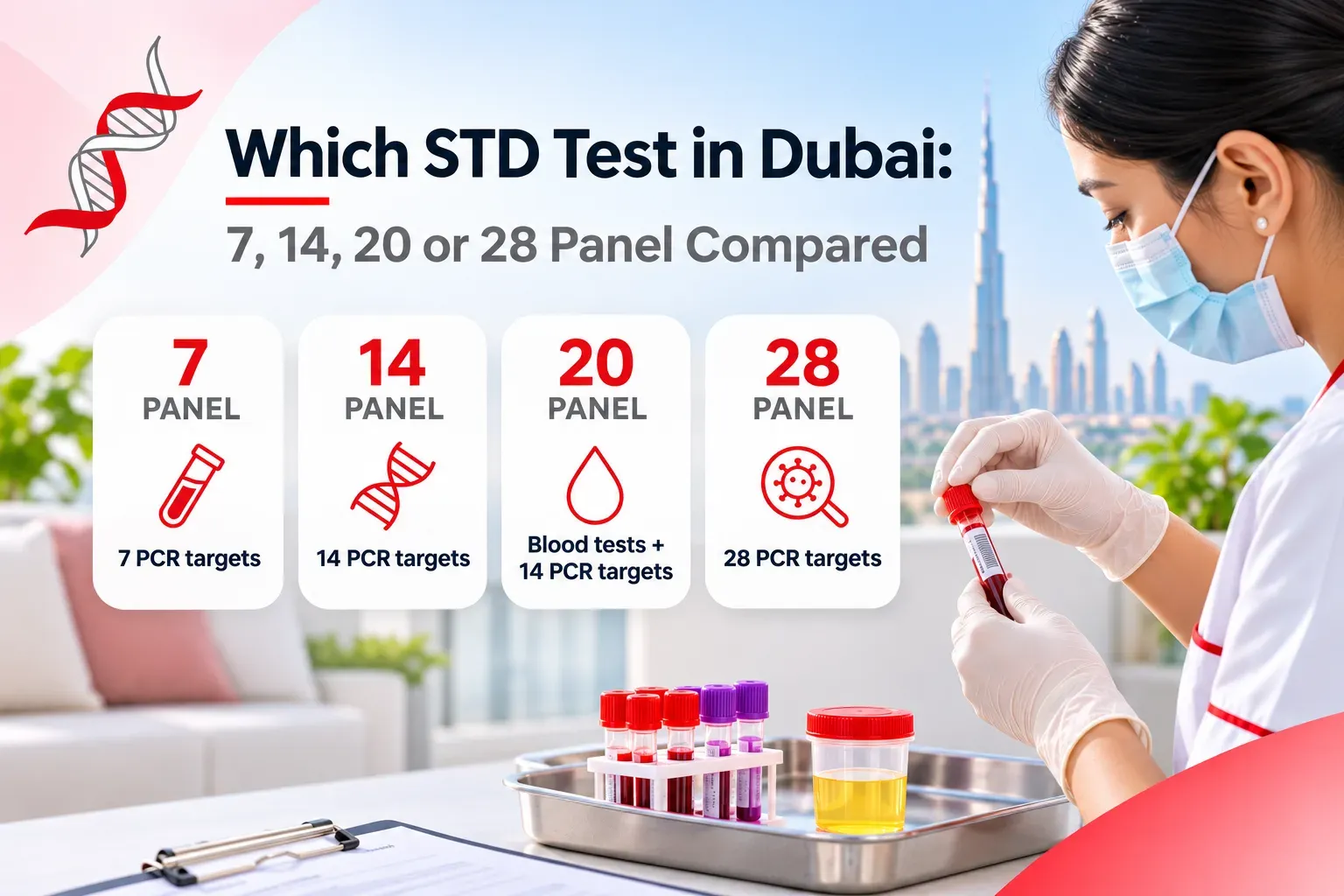
Which STD Test in Dubai: 7, 14, 20 or 28 Panel Compared
The 7, 14, 20 and 28 STD panels are not four sizes of one test. See what each one looks for and which one includes HIV and syphilis blood tests. From AED 399.
Medically Reviewed Evidence Based 10 min read·Updated 23 November 2026
DHA
DHA Compliant
Dubai Health Authority
EIAC
EIAC Accredited
ISO 15189:2022
10 min
Reading time
Medically Reviewed
Medically reviewed
Nov 2026
Last updated
7 sources
Evidence cited
On this page
Key Takeaways
The numbers 7, 14, 20 and 28 count the lines on each report; they do not rank the panels from basic to complete.
STD Advanced 20 (AED 699) is the only one of the four panels with blood tests: HIV, hepatitis B, hepatitis C and the RPR test for syphilis.
STD Master 28 (AED 999) is a urine or swab PCR panel with no blood tests, and it contains 13 of the 14 targets on the 14 panel, leaving out Group B Streptococcus.
Some targets on these panels can be present without illness: Lactobacillus species are normal vaginal bacteria, and CDC notes that approximately 10% to 20% of women carry Candida and other yeasts in the vagina.
Turnaround is 48 hours for all four panels, none needs fasting, and home collection anywhere in Dubai is included in the package price.
Intel Lab lists four STD panels with a number in the name: 7, 14, 20 and 28. Many people assume that a bigger number means a more complete test, so they either book the largest panel or worry that a smaller one has missed something. Both assumptions are wrong, because the four panels are not four sizes of one test.
This guide lists exactly what each panel looks for, what each step up adds or leaves out, and what a result can and cannot tell you.
Important: This article is for general education and does not replace medical advice. Laboratory results should always be interpreted by a licensed physician in the context of your individual history and examination.
Related package
STD Advanced 20
A 20-marker combined work-up pairing blood serology (HIV, hepatitis B & C, syphilis) with a 14-target genital PCR panel and urinalysis: a complete…
Starting at
699
Start here: the number counts targets, it is not a ranking
Testing for sexually transmitted infections is a routine, private health check, and there is no wrong reason to book one. How your privacy is handled is explained in our guide to STD testing in Dubai. The harder part is choosing a panel, so start with what the numbers mean.
Each number is the count of lines on the report. The 7, 14 and 28 are PCR panels run on urine or a swab. A PCR test looks for the genetic material of specific organisms in that sample1. The 20 is built differently: it is 5 blood markers, plus the same 14 PCR targets as the 14 panel, plus a urine analysis that is counted as one line.
Three facts follow from this, and they answer most questions about the four panels:
Only the 20 includes blood tests. The blood tests for HIV, hepatitis B, hepatitis C and syphilis (RPR) are in STD Advanced 20. They are not in the 7, the 14 or the 28.
The 20 does not have more PCR targets than the 14. It has the same 14.
The 28 is not "the 14 plus more". It contains 13 of the 14 targets and leaves out Group B Streptococcus.
The four panels side by side
Panel
Price
Sample
Turnaround
Blood tests for HIV, hepatitis B, hepatitis C and syphilis (RPR)
None of the four panels needs fasting. Home collection is included in the package price, and urine and swab samples can both be collected on a home visit.
For a urine sample, try not to pass urine for an hour or two beforehand, then collect the first part of the stream.
Related package
STD Extended 14
A 14-target PCR panel screening for the most common sexually transmitted and genital-tract infections from a single sample, including chlamydia,…
Chlamydia trachomatis and Neisseria gonorrhoeae, the bacteria that cause chlamydia and gonorrhoea. These are the two infections for which CDC recommends yearly testing in sexually active women under 253.
Trichomonas vaginalis, the parasite that causes trichomoniasis1.
Mycoplasma genitalium, a sexually transmitted bacterium1.
Mycoplasma hominis, Ureaplasma urealyticum and Ureaplasma parvum.
The last three can be present without causing illness. If one of them is reported as detected, that line is not, by itself, a diagnosis. A physician decides whether it matters in your case.
The 7 panel has no blood tests, so it does not test for HIV, hepatitis B or hepatitis C, and it has no syphilis or herpes target. It fits a reader whose question is limited to chlamydia, gonorrhoea and the other PCR targets listed above.
Related package
STD Core Screening (STD-7)
A focused 7-target PCR panel for the core bacterial STIs: chlamydia, gonorrhoea, trichomonas, plus mycoplasma and ureaplasma species.
Starting at
399
What the 14 panel adds
STD Extended 14 costs AED 499. It reports the seven targets above and seven more, which fall into two groups.
Four targets linked to genital sores
Herpes simplex virus type 1 and Herpes simplex virus type 2. CDC describes this kind of test as the most sensitive herpes test because it detects the virus from a sore. The virus is shed only some of the time, so a "not detected" result when there is no active sore does not rule out herpes1.
Treponema pallidum, the bacterium that causes syphilis. Tests that find this bacterium directly are designed for fluid or tissue from a sore. Otherwise, syphilis is identified with blood tests1, and the 14 panel has none.
Haemophilus ducreyi, the bacterium that causes chancroid. CDC reports that chancroid has declined in the United States and now appears mainly in occasional outbreaks1.
Three targets that need a physician's interpretation
Candida albicans, a yeast. CDC notes that approximately 10% to 20% of women carry Candida and other yeasts in the vagina1, which is why a finding without symptoms needs a physician's interpretation.
Gardnerella vaginalis, one of the bacteria involved in bacterial vaginosis (BV). In BV, the normal Lactobacillus bacteria of the vagina are replaced by high numbers of other bacteria1.
Group B Streptococcus. CDC describes these as bacteria that commonly live in the gastrointestinal and genital tracts and that, most of the time, are not harmful. Group B Streptococcus disease is most common in newborns4.
The 14 panel still has no blood tests. It fits a reader with symptoms such as a genital sore or an unusual discharge, where the question is wider than chlamydia and gonorrhoea. If you have symptoms, it is sensible to ask a clinician first.
Related package
STD Basic Screening
A confidential 5-in-1 blood screen for the core blood-borne STIs: HIV (1 & 2), hepatitis B, hepatitis C and syphilis.
Starting at
299
Why the 20 is a different kind of test
STD Advanced 20 costs AED 699. It is the only one of the four panels that takes blood. The 20 lines on the report are:
Five blood markers: HIV 1 & 2 Antibodies with P24 Antigen (reported as two lines, HIV I and HIV II), Hepatitis B Surface Antigen (HBsAg), Hepatitis C Antibody (Anti-HCV) and RPR (Rapid Plasma Reagin) for syphilis.
Fourteen PCR targets: exactly the same 14 as STD Extended 14.
Urine Analysis: a routine urine examination, counted as one line. This is why the 20 always needs a urine sample.
The blood tests answer questions that a urine or swab PCR panel does not ask. CDC's general advice in the United States is that everyone aged 13 to 64 should be tested for HIV at least once, and that most sexually active adults should be tested for syphilis, depending on where they live3. Among these four panels, only the 20 includes an HIV test and a syphilis blood test.
Each blood test has limits that are worth knowing before you book:
HIV. This is a fourth-generation test, which looks for HIV antibodies and the p24 antigen. UK guidelines set the window period for fourth-generation laboratory tests at 45 days2. A negative result from a sample taken sooner may need to be repeated.
Hepatitis C. Anti-HCV is an antibody test. If it is reactive, an HCV RNA test is needed to show whether infection is present now1.
Syphilis. RPR is one of two types of syphilis blood test. CDC states that one type alone is not enough for diagnosis, and that a reactive RPR should always be followed by a second type, called a treponemal test1. Intel Lab lists one, Treponema Pallidum Hemagglutination Assay (TPHA), as a single test at AED 105. A single test booked alone carries a collection fee, which is shown before payment.
If you want only the blood tests, STD Basic Screening (AED 299, turnaround 24 hours) contains the same four blood tests without the PCR panel.
What the 28 panel adds, and what it leaves out
STD Master 28 costs AED 999. It reports 13 of the 14 targets on the 14 panel (all except Group B Streptococcus) and 15 others:
Six more Candida species: Candida tropicalis, Candida krusei, Candida glabrata, Candida parapsilosis, Candida lusitaniae and Candida dubliniensis.
Six genital-flora targets: Lactobacillus spp., Mobiluncus spp., Megasphaera type 1, Atopobium vaginae, Bacteroides fragilis and BVAB-2.
Two viruses: Cytomegalovirus and Varicella zoster virus.
Lymphogranuloma venereum (LGV), which is caused by particular types of Chlamydia trachomatis (L1, L2 or L3) that can cause more severe, invasive infection than the common types1.
Why "detected" is not always an infection
Several of the 15 additions can be present without illness:
Lactobacillus species are the normal bacteria of the vagina, the ones that are replaced in BV1. Detecting them is not a sign of infection.
Mobiluncus, Megasphaera type 1, Atopobium vaginae and BVAB-2 are bacteria that CDC names in its description of BV and of BV tests1.
Candida species other than Candida albicans can also cause vaginal yeast infection, although Candida albicans is the usual cause1. The same caution applies: yeast can be present without symptoms.
Cytomegalovirus is a common virus. CDC states that in the United States over half of adults have been infected by age 40, that most people with the infection have no symptoms, and that the virus then stays in the body for life. It can pass through body fluids, including by sexual contact, and also in other ways5.
Varicella zoster virus is the virus that causes chickenpox and shingles6. It is a different virus from the two herpes simplex viruses that cause genital herpes1.
For this reason, a physician reads each "detected" line together with your symptoms and history.
What the 28 leaves out
The 28 has no blood tests. It does not include HIV 1 & 2 Antibodies with P24 Antigen, Hepatitis B Surface Antigen (HBsAg), Hepatitis C Antibody (Anti-HCV) or RPR (Rapid Plasma Reagin). Its syphilis target is the PCR for Treponema pallidum, which is designed for samples from a sore and does not replace the blood tests1. It also does not report Group B Streptococcus.
A reader who also wants the blood tests can add them separately, for example through STD Basic Screening (AED 299).
Related package
STD Master 28
Our most comprehensive 28-target STI and genital-flora PCR panel, adding candida species, bacterial-vaginosis organisms and additional viruses on top…
Starting at
999
What none of these four panels can tell you
Whether you tested too early. Every infection has a window period, the time after exposure before a test can find it. For the fourth-generation HIV test it is 45 days2. The window periods for the other infections are set out in our guide to STD testing in Dubai.
What is happening at a site that was not sampled. A PCR result describes the urine or the swab that was tested.
Whether you have HPV. None of the four panels includes HPV. Intel Lab lists it separately as HPV 32 (AED 999).
A diagnosis. A laboratory report states what was found in a sample. A licensed physician combines it with your history and examination to decide what it means.
Which panel fits your situation, and how often to test
Start from the question you want answered, not from the size of the panel.
Your question
Panel to consider
Reason
A general check without symptoms that includes HIV and syphilis
STD Advanced 20 (AED 699)
The only one of the four with blood tests, plus chlamydia and gonorrhoea by PCR
Only the HIV, hepatitis B, hepatitis C and syphilis blood tests
STD Basic Screening (AED 299)
The same four blood tests without a PCR panel
Chlamydia, gonorrhoea and the other targets on the 7 panel
STD Core Screening (STD-7) (AED 399)
Seven PCR targets, no blood tests
Symptoms such as a genital sore or an unusual discharge
STD Extended 14 (AED 499), or STD Advanced 20 if you also want the blood tests
Adds herpes, Treponema pallidum, Candida albicans and Gardnerella vaginalis targets
The widest PCR list, including more Candida species and the bacteria linked to BV
STD Master 28 (AED 999)
28 PCR targets; add STD Basic Screening if you also want the blood tests
How often to test
CDC's recommendations for the United States give a useful starting point3:
Everyone aged 13 to 64 should be tested for HIV at least once.
Sexually active women under 25 should be tested for chlamydia and gonorrhoea every year.
Women aged 25 and older with a new partner, more than one partner, or a partner who has an STI should also be tested for chlamydia and gonorrhoea every year.
Pregnant women should be tested for syphilis, HIV, hepatitis B and hepatitis C starting early in pregnancy.
CDC sets more frequent schedules for some people at higher risk, so a physician can advise what applies to you.
What to do with your result
Read the report with a licensed physician. A negative or "not detected" result from a sample taken inside the window period may need to be repeated. A "detected" or reactive result needs a physician's interpretation before any decision is made, and some blood test results need a second test to confirm them, as described above.
Book your test
For a general check that combines the HIV, hepatitis and syphilis blood tests with 14 PCR targets, the panel to look at is STD Advanced 20 (AED 699). The other three are STD Core Screening (STD-7) (AED 399), STD Extended 14 (AED 499) and STD Master 28 (AED 999). Turnaround is 48 hours for all four.
Home collection is available anywhere in Dubai, 7 days a week, 6am to 9pm. Reports are digital and physician-reviewed. Intel Lab Diagnostics holds Dubai Health Authority facility licence 00463817. If you are not sure which panel fits, ask a clinician first.
This article is for general education and is not a substitute for medical advice. A negative or "not detected" result from a sample taken too soon after an exposure does not rule out infection. Intel Lab Diagnostics is licensed by the Dubai Health Authority (licence 0046381) and accredited by EIAC to ISO 15189:2022. Prices and turnaround times were verified on 23 November 2026.
Helpful? Let us know
Was this helpful?
Laboratory tests
Related tests you can book
Health package
STD Advanced 20
A 20-marker combined work-up pairing blood serology (HIV, hepatitis B & C, syphilis) with a 14-target genital PCR panel and urinalysis: a complete…
From 699
Health package
STD Core Screening (STD-7)
A focused 7-target PCR panel for the core bacterial STIs: chlamydia, gonorrhoea, trichomonas, plus mycoplasma and ureaplasma species.
From 399
Health package
STD Extended 14
A 14-target PCR panel screening for the most common sexually transmitted and genital-tract infections from a single sample, including chlamydia,…
From 499
Health package
STD Master 28
Our most comprehensive 28-target STI and genital-flora PCR panel, adding candida species, bacterial-vaginosis organisms and additional viruses on top…
From 999
Health package
STD Basic Screening
A confidential 5-in-1 blood screen for the core blood-borne STIs: HIV (1 & 2), hepatitis B, hepatitis C and syphilis.
From 299
FAQ
Frequently Asked Questions
Common questions on this topic, answered by our lab team. Can't find yours?
It depends on the question you want answered. For a general check that includes HIV and syphilis, STD Advanced 20 (AED 699) is the only one of the four panels with blood tests. STD Core Screening (STD-7) reports seven PCR targets including chlamydia and gonorrhoea, STD Extended 14 adds targets linked to genital sores and discharge, and STD Master 28 has the widest PCR list but no blood tests. A clinician can help you choose.
They are different tests, not a better one and a worse one. STD Master 28 reports 28 PCR targets from urine or a swab and has no blood tests, so it does not include the HIV, hepatitis B, hepatitis C or RPR blood tests. STD Advanced 20 reports 5 blood markers, 14 PCR targets and a urine analysis counted as one line.
Among the four numbered panels, only STD Advanced 20 includes HIV 1 & 2 Antibodies with P24 Antigen. UK guidelines set the window period for fourth-generation laboratory HIV tests at 45 days, so a negative result from a sample taken sooner may need to be repeated. STD Basic Screening (AED 299) contains the same four blood tests without the PCR panel.
STD Core Screening (STD-7) is AED 399, STD Extended 14 is AED 499, STD Advanced 20 is AED 699 and STD Master 28 is AED 999. Home collection anywhere in Dubai is included in the package price.
None of the four panels needs fasting. The 7, 14 and 28 panels use urine or a swab. STD Advanced 20 needs blood plus urine or a swab, and it always needs urine because it includes a urine analysis.
Turnaround is 48 hours for all four panels. Reports are digital and physician-reviewed.
No. Some targets on these panels can be present without illness. Lactobacillus species are the normal bacteria of the vagina, and CDC notes that approximately 10% to 20% of women carry Candida and other yeasts in the vagina. A licensed physician should interpret the report.
STD Master 28 includes a PCR target for Treponema pallidum, the bacterium that causes syphilis, but no syphilis blood test. Tests that find this bacterium directly are designed for fluid or tissue from a sore. The RPR blood test for syphilis is in STD Advanced 20 and in STD Basic Screening.
References & Sources
This article cites peer-reviewed research and guidance from recognised medical authorities.
Specialisation: Clinical PathologyDHA Reg. No. 65077850-00725+ years experience
Dr Nirupama Sabhapathy is a DHA-licensed Specialist in Clinical Pathology and Lab Director at Intel Lab, Dubai. She oversees laboratory operations and quality assurance across every testing panel, and each abnormal result passes a specialist review before it reaches you.
Dr Nirupama Sabhapathy is a DHA-licensed Specialist in Clinical Pathology and Lab Director at Intel Lab, Dubai. She trained at the Manipal Academy of Higher Education and holds the DNB in Pathology from the National Board of Examinations, New Delhi.